OSCE Ministerial: Josep Borrel seeks legal means to force Russia to pay for Ukraine reconstruction
Russia's war against Ukraine was strongly condemned at the 29th Ministerial Council of the OSCE, Europe's largest security organisation, established to preserve peace and stability on the continent. According to the Associated Press, Russia's aggression is among the biggest challenges the OSCE has faced in its nearly 50 years of existence.
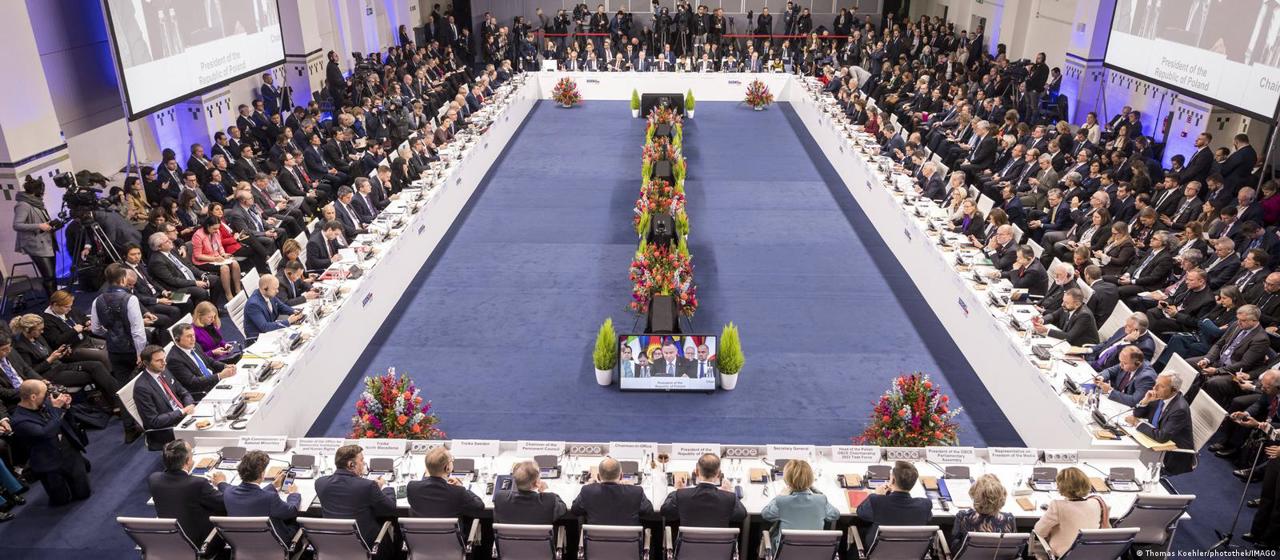
The Organization for Security and Cooperation in Europe is one of the few international bodies - along with the United Nations - where Russia and Western powers have been able to meet and discuss security-related issues, and the meeting in Łódź, Poland, is the first meeting high level since Russia's unprovoked invasion of Ukraine in last February.
Present at the OSCE meeting in Łódź, European Union foreign and security policy coordinator Josep Borrell said he intended to discuss with his counterparts all legal means by which Russia could be forced to pay for the reconstruction of Ukraine, devastated by the war started by Moscow. Josep Borrell announced that the European Union had frozen Russian assets worth almost 20 billion euros since the beginning of the invasion.
One notable absence was that of Russian Foreign Minister Sergei Lavrov, who wanted to attend the meeting but was barred from Polish territory by Warsaw, which now holds the rotating OSCE chairmanship. Poland is one of the 27 members of the European Union, and has put Lavrov on a sanctions list. "I can say with all responsibility that the OSCE "anti-presidency" of Poland will occupy the most miserable place in the history of this organisation. No one has caused such damage to the OSCE while leading it," said the head of Russian diplomacy.
Poland's acting chairman of the OSCE, Polish Foreign Minister Zbigniew Rau, said he had a responsibility to defend the "fundamental principles" of the OSCE, arguing that Russia, not Poland, had damaged the OSCE, often blocking its work. He accused Russia of spreading false information about Poland.
Before Russia's invasion of Ukraine, the OSCE acted as a mediator in Ukraine, negotiating several ceasefire agreements in the east of the country after pro-Russian separatists there, backed by Moscow, launched a war against the authorities in Kyiv. in 2014. In March 2022, the OSCE ended its special monitoring mission in Ukraine.
The representative of the United States, Under Secretary of State Victoria Nuland, is quoted by the Associated Press as saying that she came out of the Łódź meeting with renewed optimism in the OSCE, noting that 55 of the Organization's 57 members - excluding Russia and Belarus - have found new ways to work together to defend democratic principles.
The Organization for Security and Cooperation in Europe is based in Vienna and was founded in 1975, at the height of the Cold War. Its efforts to ensure security are doubled by the support of human rights and economic development, combined with military security.