Ambassador of Denmark at the Media Forum 2025: Supporting the media is an investment in the democratic resilience of the Republic of Moldova
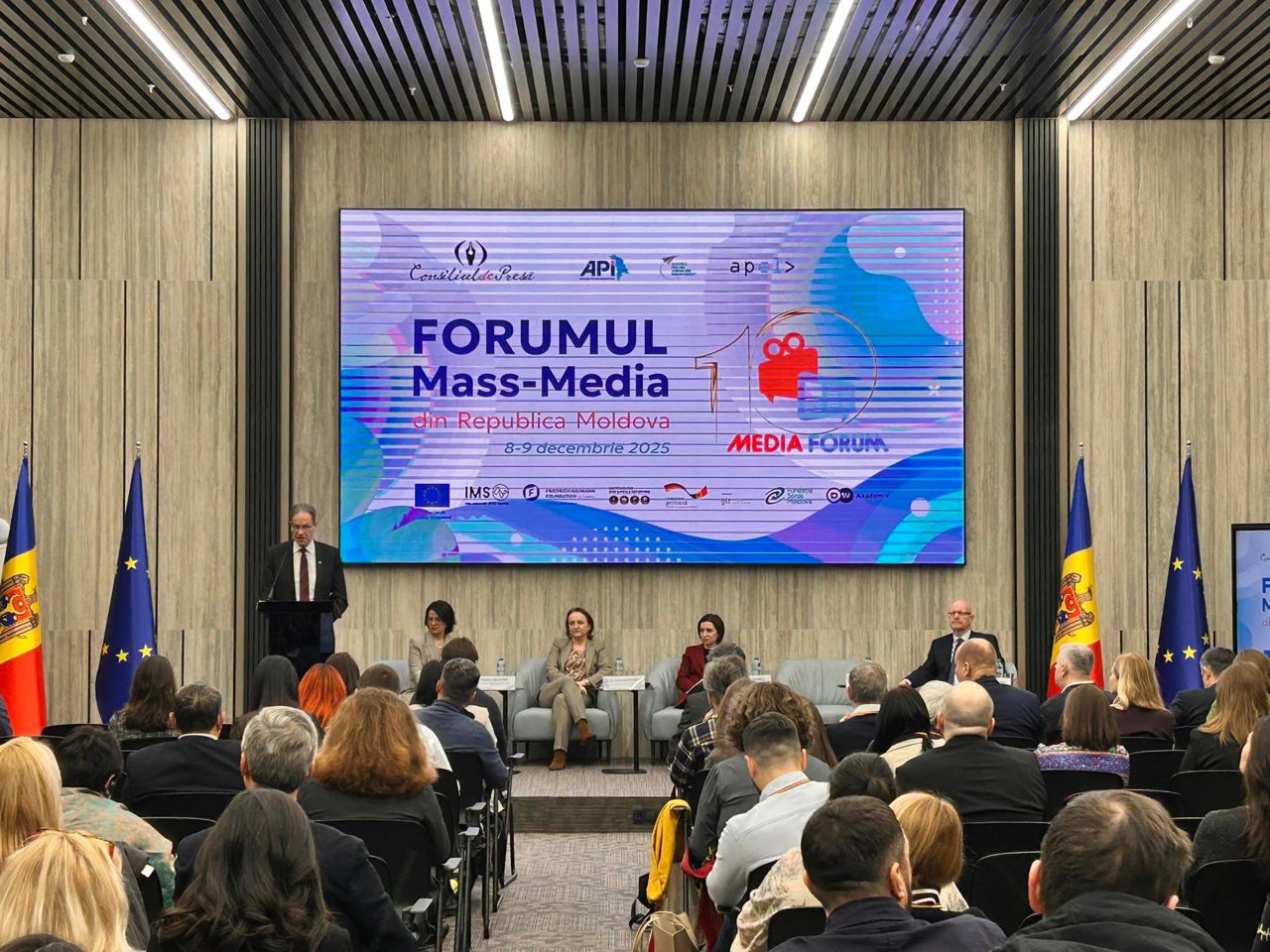
European integration, a key priority for the Republic of Moldova, cannot be understood solely through state institutions. It requires a well-prepared press that can comprehend European mechanisms, analyze relevant documents, and effectively communicate each stage of this journey to the public. President Maia Sandu conveyed this message at the Mass Media Forum 2025, which began on December 8 in Chisinau.
The head of state emphasized at the beginning of the event that "media education is no longer a luxury, but a necessity," highlighting the importance of digital literacy in defending democracy against the rising tide of disinformation.
Maia Sandu also pointed out the need to modernize the legislative framework, stating that "we can no longer defend democracy with the tools of a few decades ago." She stressed the need for clear rules regarding the online space and called for standards on transparency and accountability. "New forms of manipulation must be sanctioned," she asserted.
Additionally, she encouraged editorial offices to enhance their expertise in European affairs and to maintain a journalistic presence in Brussels. If individual resources are insufficient, she recommended that editorial offices collaborate by forming joint teams or rotating correspondents.
Maia Sandu appealed to the Ministry of Education and Research, the academic community, and the entire journalistic profession to view the training of journalists as a “common responsibility.”
“We must equip citizens with tools for informational self-defense. Media education is a necessity, not a luxury. It is important to explore how we can introduce elements of digital and media literacy in schools as an investment in the long-term health of our democracy,” she noted at the Mass-Media Forum 2025.
She acknowledged that the struggle to defend democracy is unequal, as those undermining the information space possess vastly greater resources. However, she emphasized that society has a fundamental asset—the truth—and the ability to unite in the fight.
The President also remarked that in recent years, the press in the Republic of Moldova has shown remarkable democratic maturity and has served as a pillar of resilience amid immense societal pressure.
“Through your work, you have directly contributed to the protection of democracy. Investigative journalism has become a true civic force, exposing the serious existential threats we have faced both domestically and internationally. We all know that it has not been easy. Still, you have persevered in providing accurate information and defending the public interest, even though significant support programs for the free press have been curtailed this year. As more states review their assistance policies, we must work together to develop models for sustainability and financial resilience,” Maia Sandu pointed out.
The head of state warned that the coming years will present even more complex challenges. She noted that globally, the battle for democracy will not only be fought at the ballot box and in institutions but largely in the information space; this, perhaps, represents "the hardest battle of the current generation."
Artificial intelligence as a tool for manipulation
Maia Sandu explained that "manipulation, technologies that enable nearly perfect falsifications, coordinated attacks on public trust, and propaganda heavily funded by hostile actors and disseminated through fake accounts, constitute a sophisticated arsenal that creates an extremely volatile information environment."
In this context, the president warned that the volume and aggressiveness of disinformation could exceed what we have witnessed so far in the coming years. The use of artificial intelligence, including the creation of pseudo-reality, is no longer a theoretical risk; it is already being employed on a large scale in many countries and will be directed against the Republic of Moldova with even greater intensity.
“If we do not recognize this, do not prepare, and do not unite our efforts, democracy risks being undermined by falsification and manipulation. Our internal challenges also amplify these risks. In a media ecosystem where resources are scarce, the temptation to prioritize speed or visibility over in-depth analysis is significant,” the president cautioned.
She urged forum participants to utilize this platform to discuss the development of realistic policies, clear rules, and mechanisms that can empower the press and make society more resilient.
"We also need to explore how we can enhance the capabilities of newsrooms, including through the joint use of resources. Collaboration among media institutions, sharing expertise, and utilizing shared infrastructure can be some of the most effective solutions. International examples, ranging from editorial alliances to collaborative investigations, demonstrate that sometimes less is better—and is the only realistic approach. In the near future, it will be essential to focus on improving the quality of professional training. We know that many newsrooms face a shortage of well-trained specialists, particularly on topics related to the European agenda, economy, and security," the president said.
Also, Maia Sandu said that the resilience plan recently approved by the National Security Council provides a new framework for leveraging opportunities in the coming years to strengthen the information space.
EU: Supporting the press is an investment in democracy in Moldova
The European Union is proud to support the commitment to pluralism and media independence—values that are central to European development and integration, stated Iwona Piórko, the European Union Ambassador to the Republic of Moldova.
“The recent elections have shown that supporting independent media is an investment in democracy. Therefore, the European Union will remain firmly committed to this cause. As Moldova advances on its path towards European integration, we will continue to be reliable partners, working together to ensure that the media serves as a democratic ally in promoting good governance,” Piórko said at the Mass Media Forum 2025.
German Ambassador to Chisinau, Hubert Knirsch, emphasized that many individuals currently believe they can gather sufficient information on their own, but he warned that this is a dangerous illusion. He pointed out that the volume of information is limitless, and the constant influx of texts, images, and videos makes it increasingly difficult to differentiate between valuable information and disinformation.
Knirsch stressed that disinformation can be even more harmful than ignorance, and he highlighted the vital role journalists play as the first line of defense against this issue.
"We must stay well-informed, but it is equally important to live in a society where those around us can distinguish between what is correct and what is not, allowing them to navigate this information effectively. The work of professional journalists in the media deserves our respect and full support every day. Governments must exercise caution when creating the regulatory and legal frameworks that govern media operations in the Republic of Moldova. Freedom of opinion and expression, and thus media freedom, is a fundamental pillar of democracy. In contrast, the greatest threats to democracy are those who misuse and distort information," stated Hubert Knirsch.
Additionally, Knirsch highlighted that a key principle in establishing a suitable framework for the press is transparency in all its forms, including ownership, media partnerships, and government regulations. These principles align with the expectations of the European Union for candidate countries.
Journalism: A frontline defender of democracy in the Republic of Moldova
Denmark has consistently been a reliable partner for the media in the Republic of Moldova, stated Søren Jensen, the Danish Ambassador to Chisinau. He highlighted that the support provided aims to produce verified content while also strengthening the resilience of media institutions against the uncertainties and challenges posed by new technologies, including artificial intelligence.
Ambassador Jensen also indicated that Denmark is working with media experts to update and align media legislation with European standards. He reminded everyone that last fall, Denmark announced financial support of 6 million euros to ensure that quality journalism can continue its fight against disinformation.
“In the recent elections, we faced significant challenges from disinformation emanating from Russia, as well as hybrid warfare. However, we also witnessed impressive examples of investigative journalism from both local and national outlets, demonstrating that Moldovan journalism stands at the forefront of defending democracy in Moldova,” said the diplomat.
The Ambassador emphasized that as Moldova moves toward EU accession, it is vital to build a democratic information space that is not limited to the capital. A strong local press presence is essential, and this cannot be achieved without government support.
Supporting the media is not just an investment in an economic sector; it is also an investment in the democratic resilience of the Republic of Moldova, concluded Søren Jensen, the Danish Ambassador in Chisinau.
The Mass-Media Forum 2025 will gather the Republic of Moldova's journalistic community for six debates focused on legislative priorities related to European integration. Topics will include the impact of major tech companies on press freedom, the state of the advertising market, journalist training, and international support for independent media.
In addition to the debates, the program features three workshops covering social media promotion, the use of artificial intelligence in newsrooms, and strategies for protecting against online attacks. On the first day, there will also be special events aimed at local press and investigative journalism.
As part of the Forum, professional ethics awards will be presented, the "Black book of waste of public money" will be launched, and the winners of the "Investigations of the Year 2025" competition will be announced.
The Forum will host top officials, diplomats, and international experts. This year's edition is organized by the Press Council in collaboration with the Independent Press Association, the Center for Independent Journalism, and the Electronic Press Association, with support from the European Union and several international partners.