Moldovan wines praised worldwide; winemakers say resilience paid off
Twenty years after the first Russian embargo, the wine sector has become one of the Republic of Moldova's strategic areas. It contributes around 2% to the Gross Domestic Product and provides over 150,000 jobs. The politically motivated embargoes of 2006 and 2013 severely impacted the economy and the wine industry. More than 80 wineries went bankrupt, and the area of grape plantations was reduced by 40%, which had a serious effect on the entire production chain.
Tens of thousands of people lost their jobs, but the Republic of Moldova persevered. It transformed the crisis into an opportunity, reinventing its industry and shifting its focus toward the stable and predictable Western market.
Today, Moldovan wines are among the most highly regarded in the world. While it wasn't easy, winemakers assert that they succeeded through collaboration.
According to Mihai Duca, director of a winery, “It was a shock for the entire industry. The initial measures taken by companies included staff reductions and asset sales. Many wineries sold their products in bulk, leading to the closure of those that couldn't adapt. Some simply disappeared."
Two decades ago, like most winemakers, Mihai Duca exported 80 percent of his production to the Russian market, which abruptly closed. He explained the impact: “It's like having bank loans and obligations to suppliers and employees, and then, overnight, losing 80 percent of your turnover. For instance, a company that had exports of around seven million dollars and debts of four to five million dollars found itself reduced to sales of just 1.5 million, while still holding four million in debts. From a financial perspective, that is a catastrophe."
Despite these challenges, the company, along with others in the industry, adapted to the new realities. After nearly six years, it paid off all its bank debts. Initially, accessing other markets was difficult due to a lack of regulation, but after the gradual lifting of the embargo in 2007, the winery partially returned to the Russian market. However, it completely abandoned this market in 2013 when the Kremlin imposed a new embargo in response to Moldova's closer ties with the European Union.
Mihai Duca noted, “Gradually, each producer found its niche and its market. This process takes time and requires a lot of effort and dedication. Our company focused primarily on the domestic market. We observed shifts in domestic consumption trends and worked to develop this market. For a long time, another significant export market for us was Belarus, followed by Romania, the Baltic States, Poland, and others."
The embargo imposed by Russia was a challenge for its wineries, forcing them to rethink their direction and undergo profound transformation. This period of challenges opened up new development opportunities, and today the brandy produced here reach markets in the European Union and even China. They are currently exported to ten countries, with an annual volume of approximately two million bottles.
“Until the embargo, we were producing fortified wines, dry wines and divins. One of the immediate decisions made then, in 2007, was that we would stick only with brandy. This saved us. The stocks we had at that time were an important lifeline for us to get through that crisis,” said Mihai Duca.
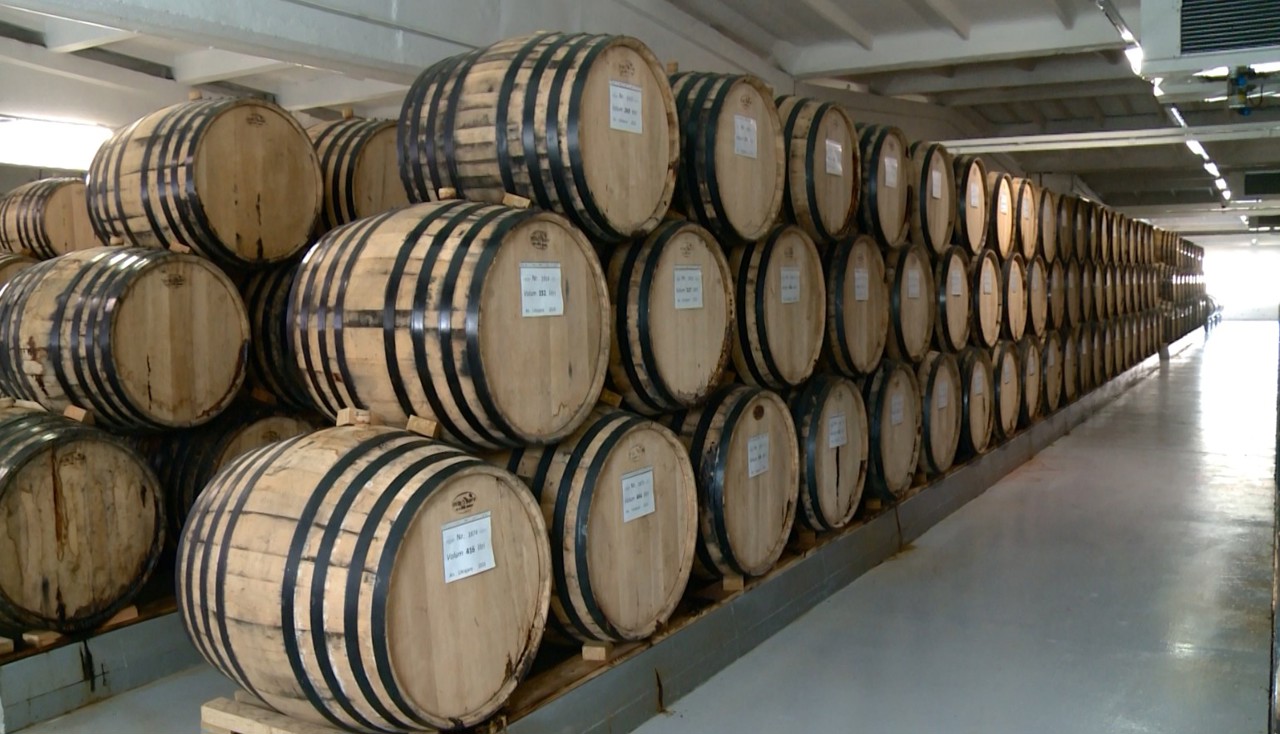
The drink is matured for at least 3 years. Thus, from the processing of the grapes until the bottles reach the market, an average of 8.5 years pass. Currently, the winery produces brandy of different ages. Some are approaching 40 years old. To achieve a more refined aroma, oak staves are added.
"The oak staves are placed in the tank, after which they are fixed and the distillate is poured. The amount of staves in this tank is five cubic meters".
The winery produces around two million bottles, 30 percent of which are exported.
"Now exports have fragmented and the type of products that are exported to the European Union, as well as others. We have other markets: Asia and Africa. That is, the market is global. That crisis in 2006 brought the industry to transform a crisis into an opportunity. Producers sought to reinvent themselves, claims Mihai Duca.