Seven European states urge urgent talks with Moldova and Ukraine; declaration signed in Chișinău
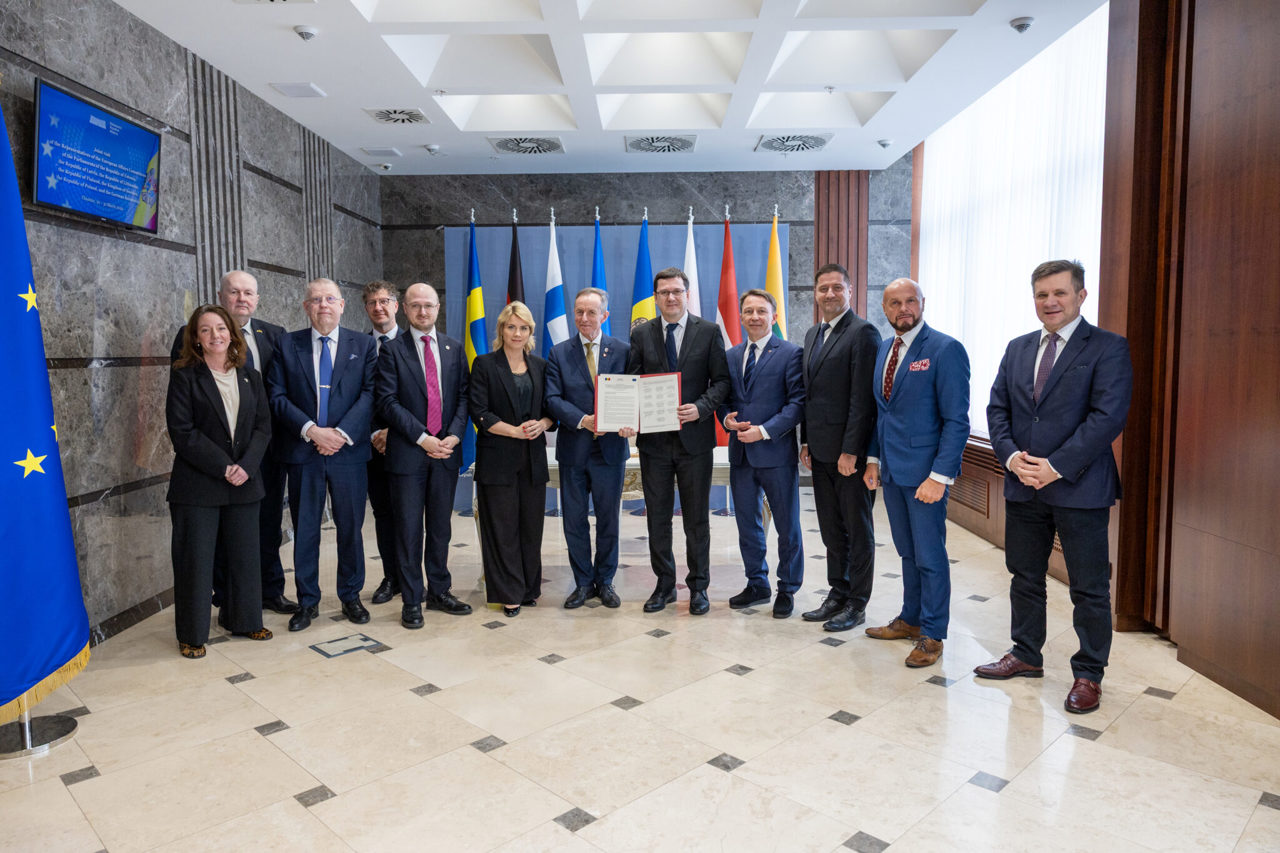
A joint declaration was signed in Chisinau during the official visit of parliamentary delegations from seven European states. This declaration reaffirms strong support for the European path of the Republic of Moldova. The document praises Moldova's determination and resilience in continuing its reform efforts despite unprecedented external pressures.
The Chairman of the Commission for European Integration, Marcel Spatari, stated at a press conference on Monday that through the signed declaration, the partners from the parliaments of Estonia, Latvia, Lithuania, Sweden, Finland, Poland and Germany reaffirm their firm support for the European path of the Republic of Moldova and welcome the significant progress in the process of accession to the European Union, as well as the efforts of the authorities to implement reforms and align legislation with the community acquis.
"It is a declaration that calls on the member states and the European Union to take the necessary measures to open formal negotiations for the accession of the Republic of Moldova to the European Union on all clusters, so that the accession process continues and is accelerated in the coming period, in order to maintain the dynamics that we have registered in the recent period", Marcel Spatari said.
Commitments for a bigger and stronger European Union
The Chairman of the Estonian Parliamentary Committee for European Affairs, Peeter Tali, highlighted the Republic of Moldova's “impressive progress” on the path to European integration.
“I can say this with certainty. We see a very strong commitment from you. I mentioned that your citizens, in three electoral exercises, despite Russian interference, chose to keep the European path. This is the will of your country, the will of your citizens. We note this impressive dedication to the integration process. Estonia fully supports the European integration of the Republic of Moldova, and we want to share our experience with you,” the Estonian parliamentarian said.
Peeter Tali added that Estonia encourages “European friends” to support the integration process of the Republic of Moldova and Ukraine. In the context of the parliamentary elections in Hungary, which will take place in April, efforts are underway to develop alternative plans aimed at removing any obstacles to the enlargement of the European Union.
“Specifically, I am referring to this approach of Victor Orbán to veto any initiative related to supporting Ukraine and the enlargement of the European Union. So, the main idea of our discussions and the signed declaration is that we want a bigger and stronger European Union,” said the Chair of the Estonian Parliamentary Committee on European Affairs.
According to the signed declaration, in the current geopolitical context, the accession of the Republic of Moldova and Ukraine to the European Union will contribute to the consolidation of peace, security, stability and prosperity, as well as to the strengthening of democratic resilience in the region.
European cooperation and mutual support
Saara-Sofia Sirén, Chairperson of the Grand Committee for European Affairs in the Finnish Parliament, mentioned the importance of cooperation within the country and with other states, as well as the joint support of European actors for EU enlargement.
“We represent different countries, but we work together to uphold these common European values in dangerous times, in uncertain times. We believe that it is very important to cooperate to preserve common values. We also want to see cooperation within each country, between parliaments and governments,” said the Finnish MP.
Erik Ottoson, Chairwoman of the Foreign Affairs Committee in the Parliament of the Kingdom of Sweden, stated that the Republic of Moldova's role in Europe is increasingly relevant. In its efforts to strengthen the European architecture, Sweden broke a tradition in Chisinau, as a member of the Swedish Parliament was the first to sign such a joint commitment.
"Anyone from abroad who comes to the Republic of Moldova is impressed by everything you have achieved. The path to accession is obvious, irreversible. And the Republic of Moldova's role in Europe is growing and becoming stronger every day. We see the steps you are taking and it is also important for the European Union, which is at a defining moment in its history. A moment when more countries are seeking this space of democracy and we want to welcome them into the European family. We see all these efforts and endeavors and this gives us hope, because there are still countries that are striving towards democracy, freedom, the rule of law and respect for human rights," the Swedish MP noted.
The role of the citizen in the accession process
The Chairman of the Committee on European Union Affairs of the Senate of the Republic of Poland, Tomasz Grodzki, said that the efforts of the authorities are important, but the defining role is played by the citizen of the Republic of Moldova, who in the last three electoral exercises has shown that the country is devoted to the European vector.
"And you can see this vector on the streets, in investments and in the development of the country. I have visited the Republic of Moldova several times and I can observe these changes, I can observe the irreversibility of this trend. This path of accession is not an easy one; it involves negotiations and many requirements that you have to meet,", the Polish parliamentarian pointed out, mentioning his country's plenary support to accelerate the accession process.
Visit of European delegations to Chisinau
Representatives of the committees for European affairs from the parliaments of Estonia, Latvia, Lithuania, Sweden, Finland, Poland and Germany are paying a joint visit to the Republic of Moldova on March 29–31, at the invitation of the Chairman of the Committee for European Integration, Marcel Spatari.
The delegation is scheduled to meet with Deputy Prime Minister for European Integration, Cristina Gherasimov, and Minister of Foreign Affairs, Mihail Popșoi. It will also have meetings with students from the Moldova State University.