Moldova launches EU-paid internships in government with €250 monthly stipend
Students and graduates aged 30 and under can actively participate in preparing Moldova's accession documents for the European Union through the fifth edition of the EU-Moldova internship program. During this two-month program, participants will work at central public institutions, receiving mentorship and a monthly scholarship of 250 euros, equivalent to 5,000 lei.
The selection criteria are described as “relaxed,” with a focus on the young people's motivation to participate in the experience, their determination, and some basic knowledge about the European Union (EU) and the process of Moldova's accession to the EU, according to Irina Cruceru, program manager at the EU Delegation to the Republic of Moldova.
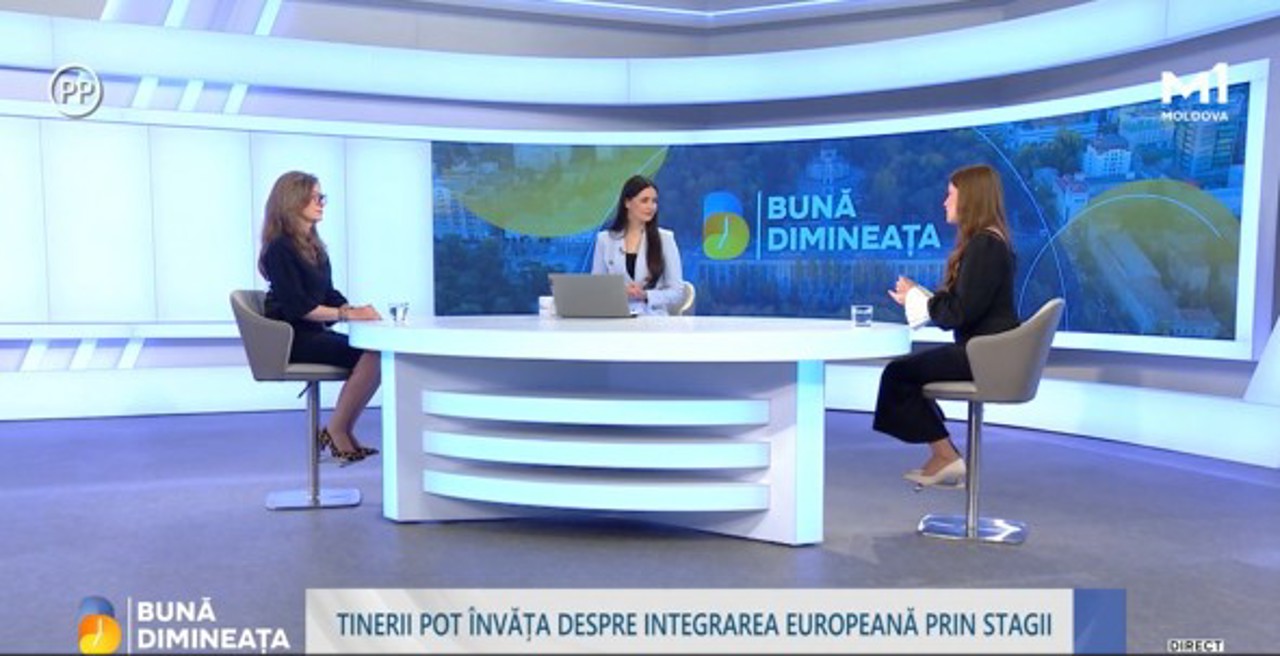
"The main goal of the program is to familiarize young people with central public administration and to encourage them to consider careers as civil servants within Moldova's institutions. This year, a new feature of the program is that interns will have the opportunity to work on the negotiation files related to EU accession. Discussions have already begun on this front, and interns will have the chance to follow and even contribute to specific files, documents, and content elements. Additionally, we have increased the scholarship this year to 250 euros," stated Irina Cruceru during the May 12 edition of the show "Bună Dimineața" on Moldova 1.
According to Cruceru, over the five years the program has been running, around 200 interns have participated, with 20 currently employed in public institutions in Moldova.
"We have a 10 percent success rate, which is quite good. This is likely more than what could be achieved simply by publishing job advertisements. It provides a glimpse behind the curtain; for example, in two months, you can find out what is happening within an institution or organization. The purpose is to gain practical insight into the field and determine whether this career path could be a good fit for you. I believe this 10 percent figure will increase, as many interns are in their first or second year of their bachelor’s degrees and are unable to stay. If, at the end of the internship, you do not decide to remain in a public position, you will be placed on a reserve list valid for one year, without having to pass the civil service exam," said Irina Cruceru.
Ruxanda Covalschi, a graduate of the program, is currently employed at the Office for European Reintegration and shares her positive internship experience.
"It all started when I saw an announcement about this internship program; I applied immediately. The application process included an interview with the EU High Councilors, and I was accepted. My first day of the internship was June 25, 2024—the exact day the EU accession negotiations were launched. The initial days were filled with energy, marked by numerous discussions and a rapid pace, which helped me appreciate the significance of my contributions. I realized that if European integration is driven by such motivated and hardworking young people, then this process will undoubtedly succeed, perhaps even sooner than we anticipate," Ruxanda explained on the same show.
Today, Ruxanda Covalschi, a university graduate from Sibiu, Romania, serves as a senior communications consultant at the Office for European Reintegration. Her mission is to help the public understand “what European integration means beyond technical terms.”
She is confident that returning home was the right choice to contribute to building the future of her country: “The changes we want and need do not happen by themselves.”
We would like to inform you that this year's internship program will occur from July 1 to August 31, 2026. This is a full-time, in-person position at a central public institution. Certificates will be provided upon successful completion of the program.
For full details and program regulations, please visit HERE.
This internship program is part of the project "Moldova is Europe – Support for EU Integration," which is funded by the European Union and Denmark.