NBS data shows ongoing population loss through migration

The population residing in the Republic of Moldova continued to decline, reaching 2.365 million at the beginning of 2026, almost 23 thousand fewer than the previous year.
The demographic decline in the Republic of Moldova is particularly pronounced in rural areas, with external migration the primary driver of the population decrease.
According to the National Bureau of Statistics (NBS), the country's population has decreased by 1%. This data refers to individuals who have predominantly lived in the Republic of Moldova for the past 12 months.
The population decline is more severe in rural areas, where the number of residents has dropped by 1.3% compared with 2025. In urban areas, the reduction is lower, at 0.6%.
"As in previous years, the decrease in population has been largely influenced by negative net international migration," states the NBS.
When examining regional demographics, the municipality of Chișinău has the highest percentage of working-age individuals and the lowest percentage of elderly residents among regions in the country. In contrast, the northern region has the lowest proportion of young people, at 19.6%, and the highest percentage of elderly individuals, at 26.5%.
Additionally, the elderly population has increased across all development regions, with the most significant rise observed in Gagauzia.
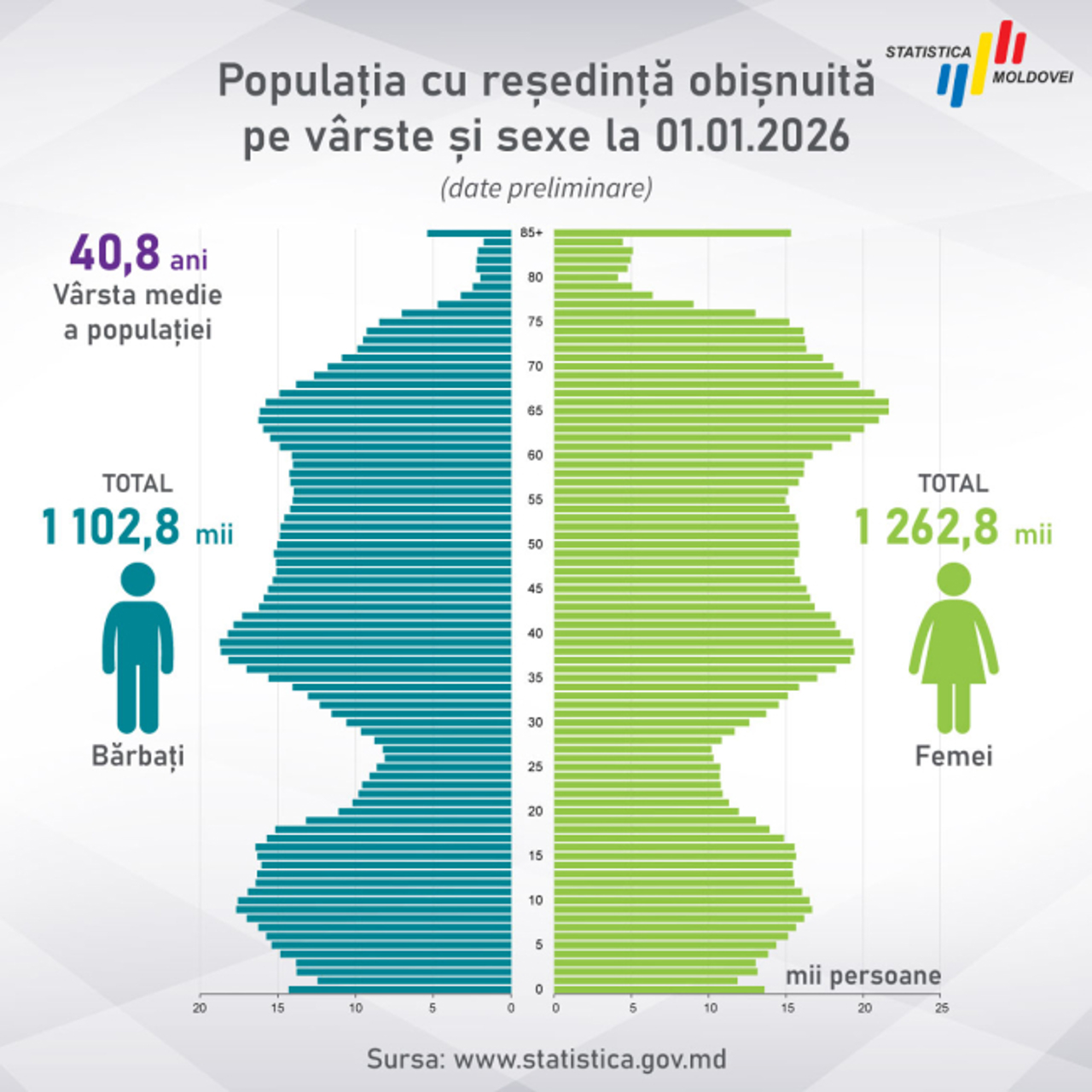
Preliminary data indicate that women continue to dominate the country's demographic structure. At the beginning of 2026, the female population numbered 1.262 million, accounting for 53.4% of the total population, while the male population stood at 1.102 million, representing 46.6%.
According to the National Bureau of Statistics (NBS), "in all districts of the Republic of Moldova, the number of women traditionally exceeds that of men." The largest gender disparities are found in the districts of Drochia, Edineț, and Ocnița, as well as in Gagauzia and the municipalities of Chișinău and Bălți, where there are fewer than 85 men for every 100 women.
In terms of age distribution, the largest population group comprises individuals aged 35 to 39, which represents 7.7% of the total. Among women, the largest share is held by those aged 65 to 69.
The NBS also reports a slight increase in the average age of the population, from 40.7 years at the beginning of 2025 to 40.8 years at the beginning of 2026.
Additionally, "the population pyramid at the beginning of 2026 clearly illustrates a decline in the population aged 25 to 29, reflecting the cumulative effects of negative net migration rates among young adults in recent decades."