PAS deputy explains why Gagauzia needs new election rules
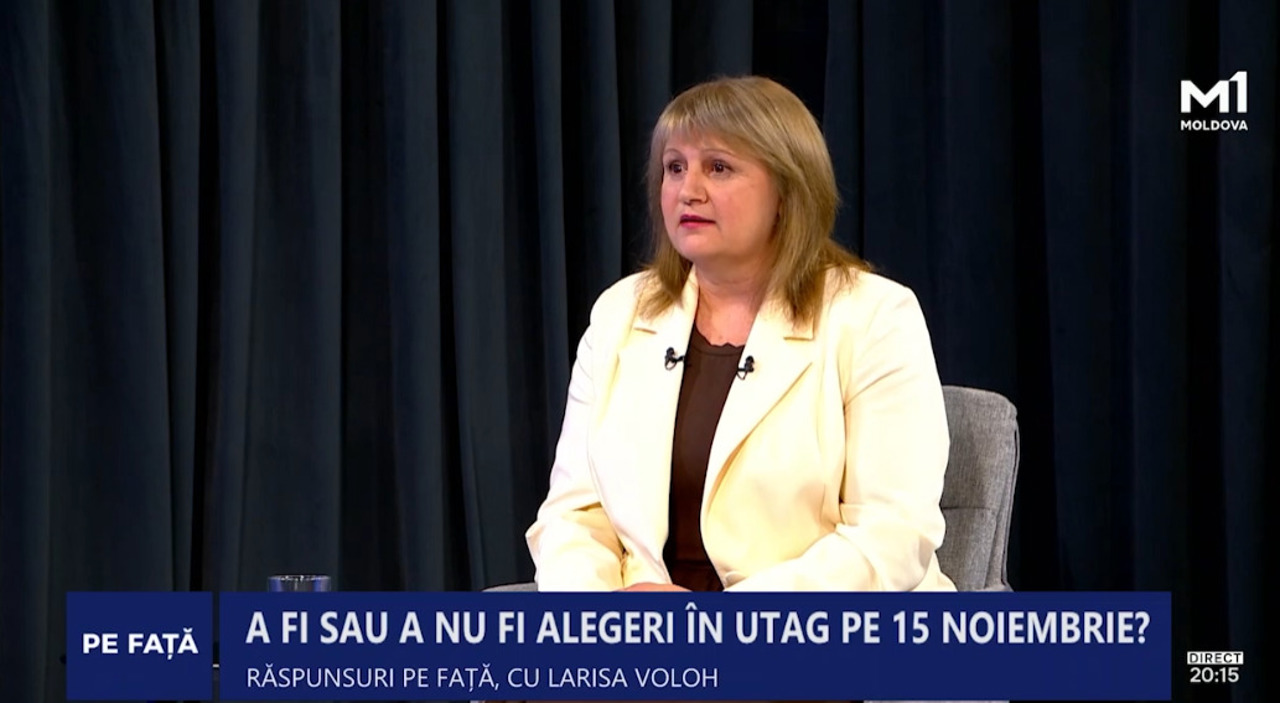
Moldova's Parliament will debate a bill on Thursday, July 30, aimed at ending nearly a year of institutional paralysis in Gagauzia, where the autonomous region's People's Assembly has an expired mandate, its Bashkan has been convicted, and a caretaker administration runs the Executive Committee without full authority. PAS deputy Larisa Voloh, who co-authored the bill amending the Electoral Code, laid out the stakes on Moldova 1's "Pe față" program on July 28.
Decisions on how institutions function, how money gets allocated, and who gets hired into the civil service have all stalled or been pushed back, she said.
What residents are losing
The paralysis touches Gagauzians' daily lives, even if not always directly, Voloh said. Without a functioning People's Assembly, the region cannot pass the normative acts it needs.
"A non-functional People's Assembly cannot approve normative acts. Sessions are essentially boycotted, and no important decisions have been made over the past year — decisions about local interests, how institutions function, equipment, all kinds of things," Voloh explained.
The same paralysis reaches the Executive Committee, which manages the autonomy's budget, allocates financial resources, and hires or dismisses civil servants. Without a legitimately elected Bashkan, those decisions now rest with a caretaker administration that carries diminished authority.
"When someone holds a full mandate, backed by the vote of the vast majority of citizens, their legitimacy is different from someone serving in a caretaker capacity," she said.
Voloh acknowledged the impact is less visible at the regional level for many residents, since mayors and local councils keep functioning normally. But she said autonomy should not become merely symbolic.
"It's a matter of principle — that this autonomy must exist, that they get to decide in their own name, that we must preserve the bodies established by law, under the special status Gagauzia obtained in 1994 as a compromise that averted a conflict," Voloh said.
Why the fix is coming only now
The bill was registered in Parliament on July 27. Voloh said Chișinău exhausted every avenue of dialogue before turning to legislation: talks were held on both the parliamentary and presidential tracks, a working group met with representatives of the Central Election Commission (CEC), and draft norms were prepared for the People's Assembly to vote on.
*"That didn't happen. Deputies in the People's Assembly assumed things would play out just as they did in 2014, 2015 and 2016 — that pressure would eventually make the central authorities back down. We were very open with them: if these talks failed, other tools existed," Voloh said.
One of those tools was a complaint the Justice Ministry filed with the Constitutional Court. Its July 9 ruling found unconstitutional the provisions letting the People's Assembly set its own election mechanisms, clearing the way for Parliament to step in.
"We chose a different tool, one that will actually get us exactly where we should have arrived anyway — just by a much friendlier, more moderate route than the one we're now proposing," Voloh added.
What the bill changes
The bill's immediate goal is to unblock the November 15 election and set clear rules for running it. It creates a new Central Election Council of Gagauzia (CECG) — a body of seven to 11 members operating under the national CEC in Chișinău, which will also appoint the council's chair.
A longer-term structural change would shift Gagauzia's assembly elections from a single-member-district system to a proportional, party-list system, the same model used for local councils. The majoritarian system will still apply, for the last time, on November 15; the proportional system would only take effect at the next election, more than four years away.
Voloh argued the shift is needed to boost the legitimacy of Gagauzia's local representatives, pointing to what she called a paradox in the current system.
"We have deputies who reached the People's Assembly backed by 150 people, 150 votes. Weigh that against the legitimacy of a mayor elected by 10,000 voters... There's a real discrepancy, and that's why we need to standardize the system and give more legitimacy to local officials who make decisions on behalf of Gagauzia's residents," she explained.
Voloh said the amendments must clear final reading by August 15 for the November 15 vote to go ahead under the new Central Election Council — an earlier deadline than the "end of August" cited elsewhere for the bill's final passage.
Does Gagauzia still need autonomy?
Voloh said she firmly supports keeping autonomy, but tied that position to the real effectiveness of regional institutions. A functional autonomy — one that builds regional policy, preserves language, culture and ethnic identity, and creates a favorable economic climate — benefits all of Moldova, she said.
"The more multicultural, the more multi-ethnic we are, the more our diversity should be a source of wealth and pride. But if we're talking about a bureaucratic, inefficient administrative system that just eats up budget money, then obviously the results are what they are," Voloh said.
She said the constant friction between Chișinău and Comrat, Gagauzia's capital, has fed a growing perception among Moldovans elsewhere that autonomy is pointless — especially while it remains dysfunctional.
*"I think it must be preserved, because it just needs to be improved. It's important for people in Gagauzia to understand why these reforms and these measures are necessary, Voloh concluded.
Central Election Commission backs the changes
On July 28, Moldova's Central Election Commission endorsed the Electoral Code amendments in a 5-3 vote. The bill, submitted by a group of PAS deputies, implements the Constitutional Court's July 9 ruling, which found that only Parliament — not the People's Assembly — has authority to regulate election law.
Lawmakers say the broader goal is to standardize how elections are run across Moldova. The bill needs to clear its first reading before the current parliamentary session ends, and final reading by the end of August, in an extraordinary sitting of Parliament.
Translation by Iurie Tataru