Moldova lawmakers clash over Russian depot at Cobasna
Moldova can only secure the evacuation of the Cobasna ammunition depot through Western-backed diplomacy under the 1999 Istanbul commitments, ruling party lawmaker Vasile Grădinaru said during a radio broadcast.
Diplomatic path vs direct dialogue
Speaking on Radio Moldova’s “La 360 de grade” program on September 7, the Action and Solidarity Party (PAS) lawmaker emphasized that Moscow does not treat Chișinău as an equal partner. “It is evident that this can only be achieved diplomatically, in communication with the Russian Federation, as established in the Istanbul agreements,” Grădinaru said. “However, we do not communicate with the Russian Federation today because it does not perceive Moldova as an equal state, but as a vassal.”
Grădinaru insisted that the complete withdrawal of Soviet-era munitions from Moldova’s breakaway eastern districts remains essential regardless of the exact tonnage stored on-site. He ruled out any non-diplomatic mechanisms, adding that negotiations cannot succeed without European and American backing. “Even if we had direct discussions with the Russian Federation, this will most likely not happen without the involvement of our European and American partners,” he explained.
In contrast, Alexandru Verșinin, a lawmaker representing the Democrația Acasă (Democracy at Home) Party, argued that Chișinău must eventually establish direct communication with Moscow in the interest of national security. “One day, we will have to find a common language with the Russian Federation as well, because we see that American partners also talk to them,” Verșinin said. He noted that Moldova’s leadership cannot passively wait for Russia to act, suggesting that European partners or the OSCE could facilitate the process.
Dispute over declassified intelligence
Verșinin also questioned the public communication strategy surrounding a declassified intelligence assessment released on August 21 by Moldova's Information and Security Service (SIS) and the Military Intelligence Agency. “I did not understand the logic of the SIS director in releasing such messages into the public space,” Verșinin said. He asked whether the revised figures—pointing to reduced explosive tonnage—were intended to reassure the public or send signals to Moscow and Brussels.
Verșinin, who was recently added to Ukraine’s Mirotvorets database over alleged Russian propaganda, emphasized that the ultimate goal must remain the unconditional withdrawal of foreign troops from the left bank of the Dniester. “The real and primary objective must be how these munitions and the occupation army are withdrawn from the left bank of the Dniester,” he noted.
Intelligence debunks apocalyptic threat
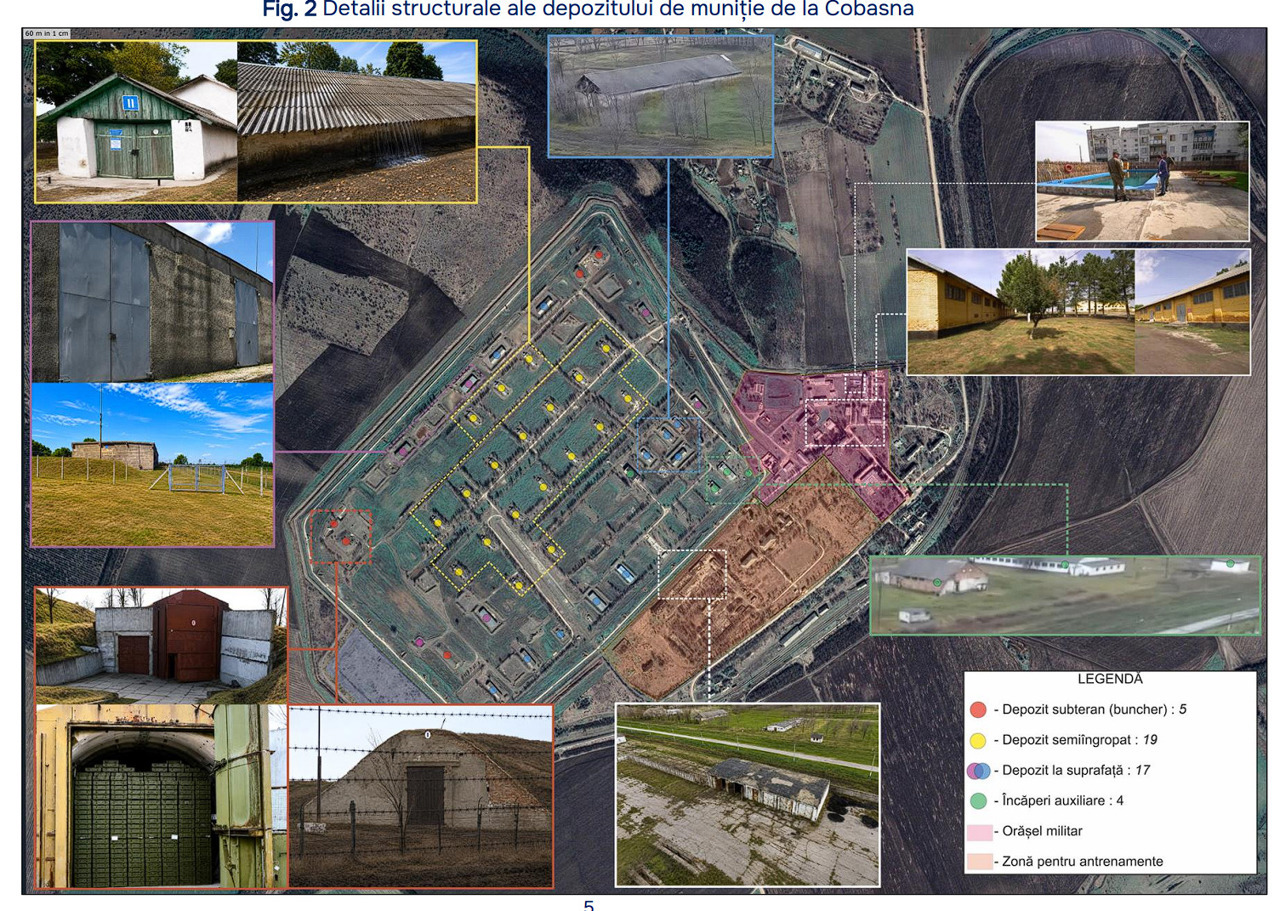
The joint report by the SIS and military intelligence concluded that the security hazard posed by the Cobasna depot has been artificially exaggerated for over two decades by Moscow and the separatist authorities in Tiraspol. While regional authorities had long cited stockpiles of 20,000 metric tons, intelligence findings indicate that only approximately 14,000 tons remain, with an actual explosive charge of just 2,800 tons. This technical data directly refutes recurrent claims of a potential regional catastrophe.
SIS Director Alexandru Musteața stated that an accidental blast would affect only an immediate two-kilometer radius and a single adjacent community, rather than triggering a Hiroshima-scale disaster. “A bomb like the one at Hiroshima is equivalent to 15,000 tons of TNT, roughly 1,500 times more powerful than the strongest conventional munition stored at Cobasna,” Musteața said. He explained that a catastrophe would require 1,500 conventional ten-ton bombs to detonate simultaneously in a single location, which is technically impossible under current storage conditions.
Translation by Iurie Tataru
RELATED COVERAGE
- OSCE's Christopher Smith to Maia Sandu: "I will always be an honest mediator"
- Serghei Shoigu: Russia will take all necessary steps to protect its citizens in Transnistrian region
- Russian troops in Transnistria pose security risks to Moldova
- Moldova demands Russian troop withdrawal from Transnistria
- Chișinău urges Joint Control Commission to review Russian drone airspace violations