Moldova prepares for participation in EGTC for local European integration
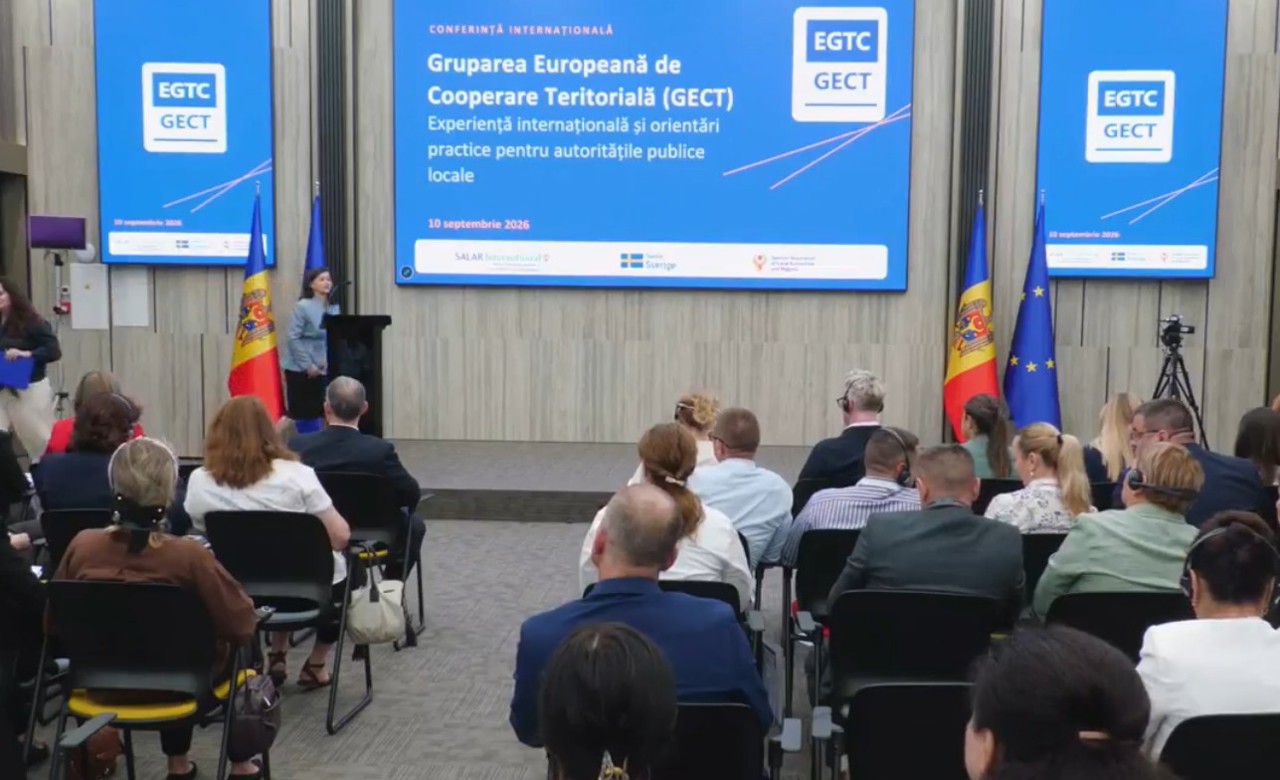
Local authorities in the Republic of Moldova can collaborate directly with partners from European Union states through European Groupings of Territorial Cooperation (EGTC). The Government is expected to soon approve a draft decision to implement the Law on EGTC.
The law governing the participation of entities from the Republic of Moldova in the European Groupings of Territorial Cooperation (EGTC) was recently adopted. Diana Chiriac, Head of the Local Public Administration Directorate within the State Chancellery, announced at a conference on international experience and practical guidelines for the EGTC, held on September 10, that the Executive has three months to draft the necessary regulatory act to implement it.
“In September, we plan to present this draft decision to the Government for approval,” stated Diana Chiriac.
European Groupings of Territorial Cooperation serve as an additional tool for local councils, complementing inter-community development associations and voluntary merger efforts.
“One of the tools for the development of city halls was voluntary merging. Now we are in the process of normative merger. And we now have another opportunity, an equally interesting tool for local public authorities, which is called EGTC. The members of this group are from different fields - a very good symbiosis of cooperation”, noted Diana Chiriac.
European Groupings of Territorial Cooperation allow public authorities from different states to institutionalize cooperation and carry out joint projects. Unlike traditional partnerships, EGTC can offer a more stable legal and institutional structure, said Patricia Varzari, a representative of a project financed by the Government of Sweden, at the event.
“Most of the time, these relationships are linked to a specific project, to a specific funding or to a specific implementation period. And here, EGTC, in fact, introduces a different possibility, that of transforming territorial cooperation into a more stable and sustainable legal and institutional structure”, stated Patricia Varzari.
According to her, local authorities in the Republic of Moldova already have numerous partnerships with localities and regions in the European Union, but the new instrument can expand these forms of cooperation.
“The fact that the Republic of Moldova now has the necessary legal framework for the participation of our entities in the EGTC opens up a new opportunity for public authorities”, added Varzari.
“Accession to the EU must also occur at the local level”
The EGTC can become an instrument of European integration at the local level, even before the Republic of Moldova accedes to the European Union, the head of the Office for European Integration, Ghenadie Marian, was keen to point out.
“From this perspective, the EGTC represents more than a legal instrument. It can become a practical instrument of European integration at the local level, we can even talk about accelerated integration. We are considering our integration even before accession to the European Union”, declared Ghenadie Marian.
The official stressed that local authorities' role will grow as the Republic of Moldova advances in the European integration process and that they must be prepared to manage projects financed by European funds.
“Accession to the European Union will not be achieved only through accession negotiations, only through the harmonization of legislation or the activity of central institutions. This must also occur at the local level. So, we are talking about better public services, modern infrastructure, economic development, connectivity, and new opportunities for society. Because, often, we create opportunities, but we do not have the capacity to capitalize on them”, Marian noted.
European experience shows that forming an EGTC can be a long process. Ocskay Gyula, Secretary General of the European Central Service for Cross-Border Initiatives, explained that the process can last up to ten years, although some groupings are created in just a few months. According to him, the interested authorities must first identify the objectives of the cooperation, establish the structure of the grouping and draw up the convention and statute. Subsequently, the competent authorities must approve it.
“If you are a local authority, then you must obtain approval from the Local Council and you must also request approval from the national authority, which, in the case of the Republic of Moldova, is the State Chancellery”, explained the expert.
There are currently 93 EGTCs at the European Union level, according to Klaus Boele, policy officer for the COTER Commission of the European Committee of the Regions. He said the groupings can bring together public authorities at the national, regional, or local level and can be used to implement cooperation projects, including with European financial support.
“The EGTC is a legal instrument; it aims to facilitate cooperation. I would like to point out that this aim is not to initiate cooperation, but to facilitate cooperation and improve territorial cooperation activities throughout the EU, including with neighbouring countries”, said Klaus Boele.
He said that EGTCs can also manage infrastructure or services of general economic interest, but certain areas are excluded.
“The following tasks are explicitly excluded: police and regulatory powers, justice and foreign policy. So you cannot manage police activity or border management through this instrument”, explained the expert.
Larisa Voloh, the Vice-Chair of the Parliament’s Committee on Public Administration and Regional Development, encouraged local authorities to utilize European resources and collaborate on joint projects with external partners.
“My message to the authorities is one of encouragement. Do not hesitate to seek out partners, initiate projects, and take advantage of the available European instruments,” stated Larisa Voloh.
Who can participate in an EGTC
The Republic of Moldova can participate in the establishment of or join a European Grouping of Territorial Cooperation if it has a regulatory framework compatible with European Union rules, explains the national legal expert in the field of EGTC regulation, Natalia Roșca.
“The European Union regulation provides that third countries can participate in the establishment of an EGTC or join an EGTC, if they have regulations, a regulatory framework similar to those of EU states and if, in general, they meet the requirements set out in the regulation”, explained Natalia Roșca.
In the Republic of Moldova, the legal framework is established by the Law on the participation of the Republic of Moldova in European groupings of territorial cooperation (EGTC) and for the amendment of certain normative acts, adopted by the Parliament of the Republic of Moldova in the summer of 2026, which regulates the manner of establishment and recognition of EGTC. According to the expert, the Republic of Moldova recognises the grouping as a legal entity, and it may have rights similar to other subjects with this status.
“Eligible for participation in an EGTC are specialized central public authorities, territorial units, administrative-territorial units, not local public authorities. So, the subject is the administrative-territorial unit, not the council or the mayor”, said Natalia Roșca.
Eligibility is only the first stage. Effective participation in an EGTC requires approval at both local and central levels. At the local level, the interested institution must adopt a decision to participate in establishing such a grouping or to join an existing one. Next, the Government must consent.
“Participation in the EGTC can only take place if both stages are passed”, said the expert.
The State Chancellery manages the file examination procedure. In the first ten working days, the institution checks whether the submitted file is complete. In total, the Government has up to 60 days to grant consent or refuse participation. The deadline may be suspended if additional documents or information are required.
Other authorities considered relevant may also be consulted during the approval process, to determine whether participation in the EGTC is justified and reasonable. Natalia Roșca also highlights the risk of overlapping funding. Projects implemented through the EGTC must not duplicate other projects or programs already financed from funds available to the Republic of Moldova. EGTCs can be used for cross-border, transnational or interregional cooperation and aim, in particular, to implement joint projects of public interest and services of general economic interest, including with European funding.
At the same time, these structures cannot take on tasks that belong exclusively to the state's public power.
“It cannot be in the field of public order, security, health, taxation”, said Roșca.
Also, participation in an EGTC does not allow circumvention of the rules on the use of public money. Financial control remains the responsibility of the competent authorities of the Republic of Moldova, including the Court of Accounts and the Financial Inspection. Also, as the lawyer noted, national control authorities must collaborate with European authorities or authorities of other EGTC member states to verify the use of EGTC money.