Moldovans face frequent police and hospital discrimination

Moldovans feel the least discriminated against in their interactions with banks, shops, public institutions, and within their families, whereas political life, hospitals, outpatient clinics, and the police are perceived as the primary settings where discrimination occurs. These findings are presented in the fifth edition of the Study on the Perception of Human Rights in the Republic of Moldova.
The data were analyzed through the lens of two main dimensions: the identification and observation of instances of discrimination across ten distinct areas of social life, and an assessment of the extent to which gender equality is upheld in the pursuit of professional and personal development.
Overall, 61% of respondents state that the right to equality and non-discrimination is respected to a large or very large extent. At the same time, discrimination is still perceived as being present in various aspects of daily life. On average, 17% of respondents believe that such situations occur often or very often.
The primary settings where discrimination is reported include political life (25%), healthcare institutions (22%), the social protection sector, and interactions with the police (18%).
Conversely, instances of discrimination are not perceived as a frequent occurrence in dealings with banks and shops (80%), within the family (74%), in interactions with public authorities (73%), or in the workplace and educational institutions (70%).
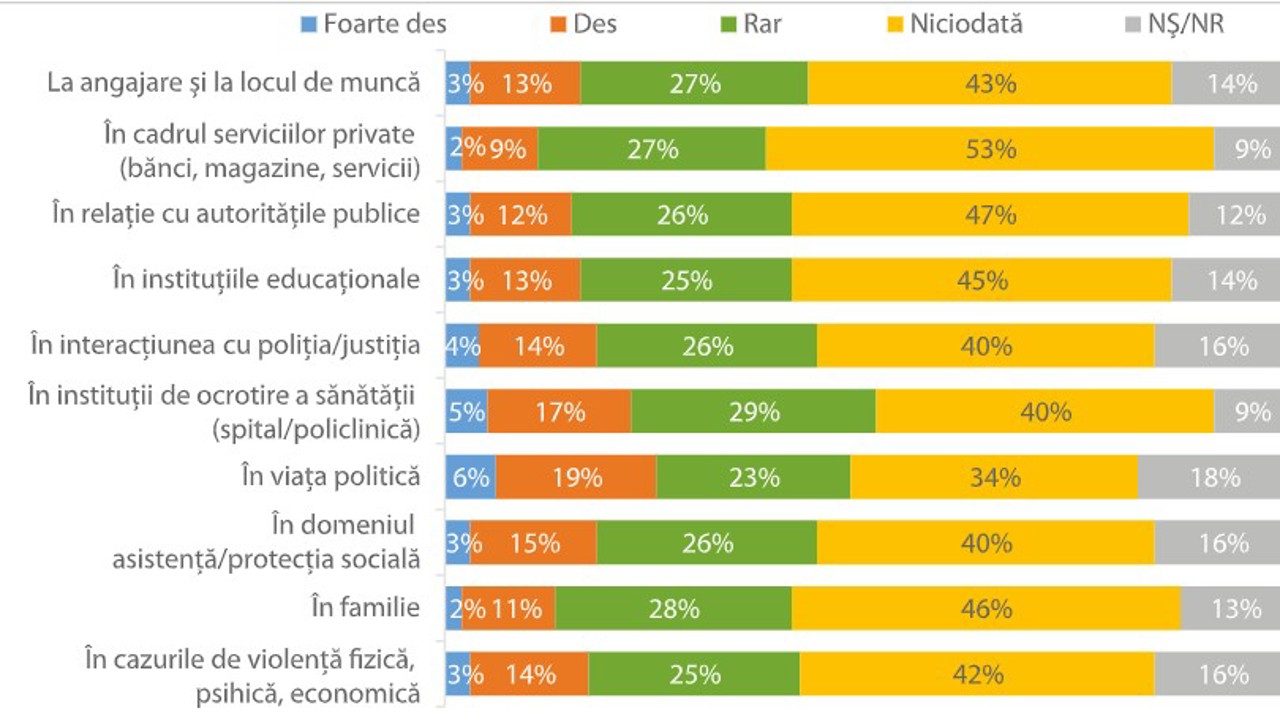
The study reveals that 69% of respondents witnessed at least one instance of discrimination—across the ten contexts measured—over the past 12 months, while 31% either did not observe any such situations or do not recall doing so. Furthermore, 42% reported encountering such situations often or very often.
According to an in-depth analysis within the study, the profile of an individual who observes incidents of discrimination is as follows: they are from the central region (83%), are young (83%), possess a high level of education (79%), belong to the majority ethnic group (71%), have a family with minor children (78%), and are informed about human rights (72%).
The study was conducted nationwide—excluding the Transnistrian region—and included respondents from both rural and urban areas, covering a total of 144 localities across the Republic of Moldova. The margin of error is ±3.1%.
Data were collected between December 17, 2025, and February 13, 2026.