Dumitru and Lana: Ukrainian refugees learning Romanian in Moldova
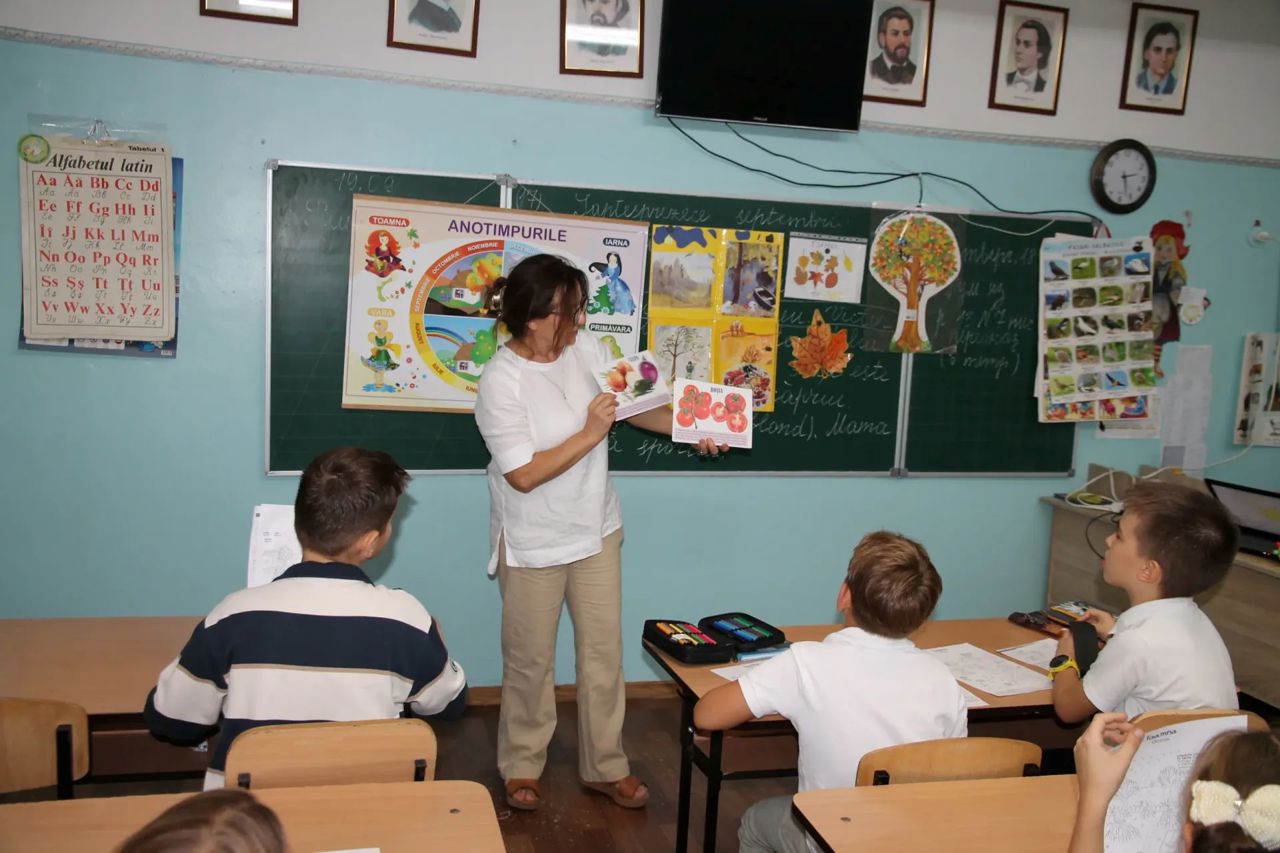
In Popeasca village, Ștefan Vodă district, several Ukrainian refugees are finding solace and starting to forget the hardships of war by taking their first steps in a new language.
Among them is Dumitru, a 13-year-old boy from Sumy, who splits his time between the Russian school in the district center and the village gymnasium, where he gradually gets accustomed to the sounds of Romanian—the language of the country that has become his second home.
Dumitru arrived with his family in Popeasca village three months ago. He dedicates his time equally to the Russian-language school and the Romanian language classes at the village gymnasium. Slowly, he masters the first Romanian words, bringing them home to share the new expressions with his parents.
"Bună ziua (Hello), 13 ani (13 years old), salam, cașcaval (cheese), ceai (tea), cafea (coffee), biscuiți (biscuits), sare (salt), zahăr (sugar), apă (water)," are the essential words Dumitru has learned so far.
Lana, another Ukrainian refugee student from Oleksandria, attends classes with Dumitru. Having been in the Republic of Moldova for over a year, she confidently introduced herself in Romanian and demonstrated her counting skills upon meeting our team.
"Bună ziua, mă numesc Lana, am 13 ani. Un, două, trei, patru, cinci, șase, șapte, opt, nouă, zece," (Hello, my name is Lana, I am 13 years old. One, two, three, four, five, six, seven, eight, nine, ten) the girl recited in fluent Romanian.
Their guide on this linguistic journey is teacher Maria Caraman. She helps them read, learn basic math, and assimilate simple, everyday expressions.
"The children are diverse; we have Roma and Ukrainian refugees. They attend the Russian school in Ștefan Vodă and get involved—some more, some less—but they all strive to come regularly," says the teacher.
Classes begin with the alphabet, move to reading exercises, and conclude with practical activities and games.
"It's a bit complicated because they range in age from seven to sixteen. The older students progress faster; the younger ones take smaller steps. But we cover the primer, a little math, and creative activities like drawing. We learn new words, pronounce them, try to translate, and laugh together," confesses Maria Caraman. She also shared the story of one ambitious boy who "came in September and is already trying to speak in simple sentences in Romanian."
The Romanian language courses are possible thanks to a partnership signed in April 2024 between the Popeasca gymnasium and the Union of Young Roma from the Republica Moldova, with financial UNHCR support.
School director Diana Zmeu mentioned that the institution set aside a special classroom for these activities.
"The number of children is inconsistent due to the refugee flow—some arrive, others leave. Children attend classes from 2:00 PM until 3:00 PM or 4:00 PM. We usually have 8 to 10 students, and the lessons have been held from Monday to Friday for a year and a half. It is challenging for the children to learn Romanian, but they are slowly making progress," affirms the director.
A temporary placement center for Ukrainian refugees is also operating in Popeasca village.
According to official data, approximately 1.9 million Ukrainians have transited the Republic of Moldova since the start of the war, and over 130,000 have chosen to remain in the country. Of those who stayed, more than 20,000 are of preschool or school age.
Translation by Iurie Tataru