“Our identity and language strengthened”: Ireland as EU accession model
Ireland serves as a strong example of how EU membership can significantly change a country. The Republic of Moldova could follow a similar trajectory with the help of member states, including Ireland. According to Thomas Byrne, Ireland's Minister for European Affairs and Defence, EU membership has greatly influenced the country's economic, social, and cultural development. His experience demonstrates how transformative this process can be for a candidate state.
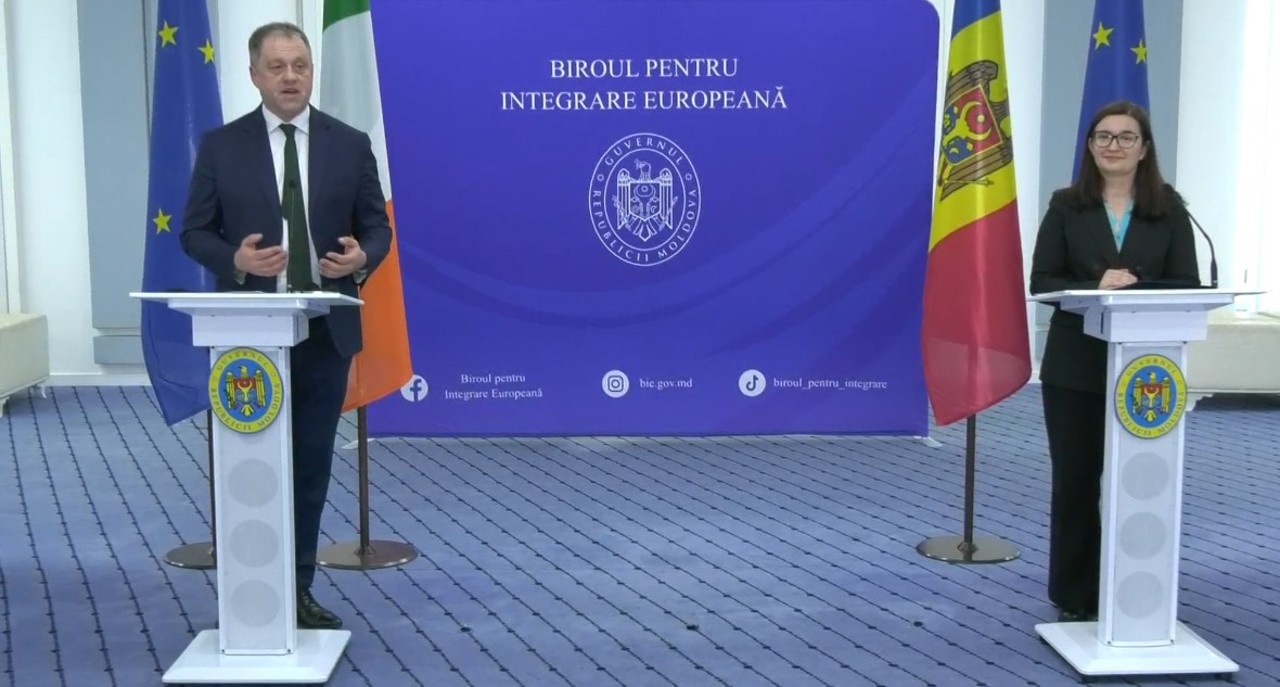
A country’s accession to the European Union can be truly transformative. Thomas Byrne emphasized this during a press conference in Chisinau on Wednesday, March 17, alongside Deputy Prime Minister for European Integration, Cristina Gherasimov. He pointed out that joining the EU significantly changed Ireland, mentioning, “Our economy has progressed tremendously. Before joining the EU, our working-age population was one million; now it is 2.7 million. Our identity and language have also become stronger since we joined the European Union.”
Single market, investments, and jobs
Byrne highlighted that one of the key advantages of EU membership is access to the European single market. This access has provided investors with predictability and confidence. He stated, “Investors come to Ireland primarily because we are part of the EU's single market. They have that certainty; they know the rules and can trust that their goods and services will be exported throughout the European Union. These benefits are very tangible in terms of employment.”
The Irish minister also noted that the European Union has supported Ireland during challenging times, including the financial crisis and Brexit, as well as during the peace process in Ireland. He reflected on the 1998 Good Friday Agreement, which laid the foundation for peace after decades of violence between unionists and republicans.
“In 2008, we faced a difficult situation, and the European Union supported us. We encountered issues with Brexit, and the European Union stood by us. When we were working towards achieving peace in Ireland, which was successfully established in 1998, the EU was there for us and supported this process,” Byrne said.
In addition to economic and political advantages, Byrne highlighted the cultural benefits of EU membership. He argued that being part of the union has enhanced Ireland’s national identity and increased visibility for the Irish language and culture.
“The main benefit that people often overlook is the cultural aspect. Being part of this diverse European community allows me to speak in Irish. For instance, my colleagues from Lithuania can understand what I’m saying. This greatly boosts our national self-confidence and enhances our credibility,” Thomas Byrne noted.
Ireland Promises Support for the European path of the Republic of Moldova
The Irish government has expressed strong support for the Republic of Moldova’s European aspirations. Irish official Thomas Byrne assured that Dublin would continue to assist the authorities in Chișinău.
"It is a merit-based process in the European Union, but I can commit to helping you, whether during Ireland's presidency of the Council of the European Union or simply as a member state of the European Union. We will help you along this path so that you, too, can sit at the European table and contribute, while receiving the associated benefits," Byrne stated.
Cristina Gherasimov, the Deputy Prime Minister for European Integration, emphasized that Ireland not only supports Moldova politically but also acts as a concrete partner in advancing the accession process.
"My recent visit to Dublin confirmed that we have a political supporter in Ireland, as well as a concrete partner that provides expertise and supports the opening of accession negotiations with our country through official channels," Gherasimov said.
She also noted that Moldova has made significant progress in its European journey recently, particularly with the opening of technical negotiations for the last three groups of chapters. Gherasimov highlighted the importance of the pace of these negotiations, especially in the current regional and geopolitical context.
"Our country's objective remains very clear: we aim to open negotiations as soon as possible. The pace of these negotiations is crucial for us because this geopolitical window of opportunity will not remain open indefinitely," she remarked.
Furthermore, Gherasimov pointed out that Ireland serves as a relevant model for Moldova, particularly in how European integration has modernized the country and created opportunities for its citizens.
"Ireland is, of course, a clear example for us of how European integration can transform a nation through investments, innovation, and opportunities for its citizens," she stated.
The officials also discussed ways to enhance bilateral relations between the Republic of Moldova and Ireland, including strengthening diplomatic cooperation. A significant role in this relationship is played by the Moldovan diaspora in Ireland, which both officials acknowledged as an important link between Chișinău and Dublin.
“The Moldovan diaspora in Ireland is a strong bridge between our countries. Thousands of Moldovans live and work there, actively contributing and strengthening this relationship every day,” Gherasimov noted.
In turn, Thomas Byrne highlighted that Moldovans in Ireland are valued for their integration and contributions to Irish society.
“We consider Moldovans to be hardworking, productive, and very interested in our society and country. Moldovan people living in Ireland are highly respected here,” the Irish minister asserted.
Byrne's visit to Chișinău coincided with Moldova's recent opening of technical negotiations for the remaining chapters related to its accession to the European Union, marking progress in all areas. Before arriving in Chișinău, he visited Ukraine and Poland, and his trip to the region is significant as Ireland is set to take over the rotating presidency of the Council of the European Union in July.