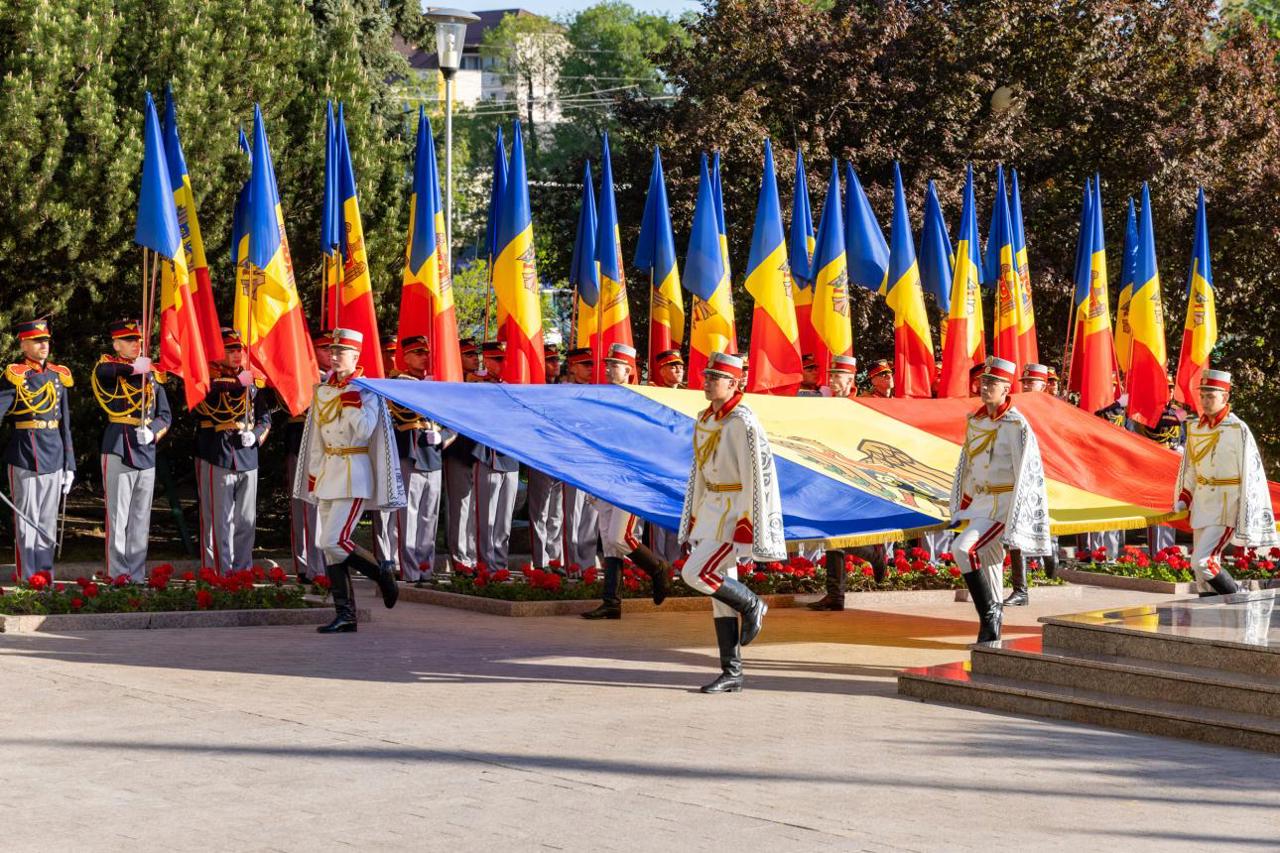
National Flag Day: How the tricolor overcame Soviet rule on April 27, 1990
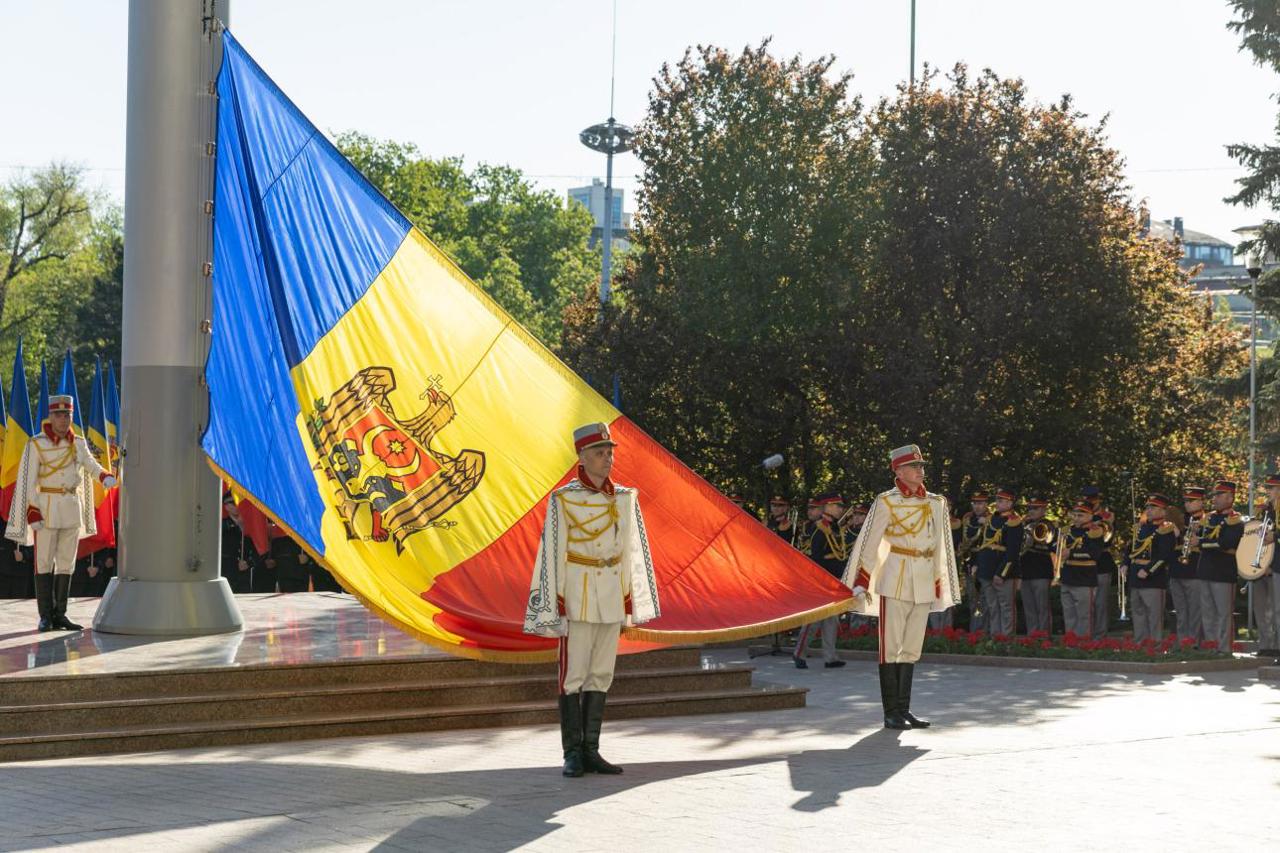
Between the demand for freedom in the streets during the late 1980s and early 1990s and the restrictions imposed during decades of Soviet occupation, the tricolour, which was "born" after 1800, stands as a powerful symbol of a nation that refused to forget its identity.
The state flag of the Republic of Moldova was officially adopted on April 27, 1990, by the Supreme Soviet of the Moldovan Soviet Socialist Republic (MSSR), initially without a coat of arms. The history of this flag is rich and deeply connected to the struggles of the Moldovan people. It was first waved by young Moldovans and mountain people in Paris in 1848, during the revolts of Bassarabians against the Russian Empire in the early 1900s, and by Gheorghe Muruziuc, who raised the three colors on the chimney of the Biruința factory in 1966—a gesture that led to severe punishment by the KGB. Gheorghe Ghimpu was the first to take down the Soviet flag and raise the tricolour on the Parliament building, symbolising a pivotal moment in the nation's history. The flag represents the sacrifices made by those who defended the state's sovereignty along the Nistru.
Today, the history of the tricolor continues to be written by those who honor the sacrifices of their ancestors, by individuals who genuinely value freedom, and by those who proudly wave the state flag on international stages.
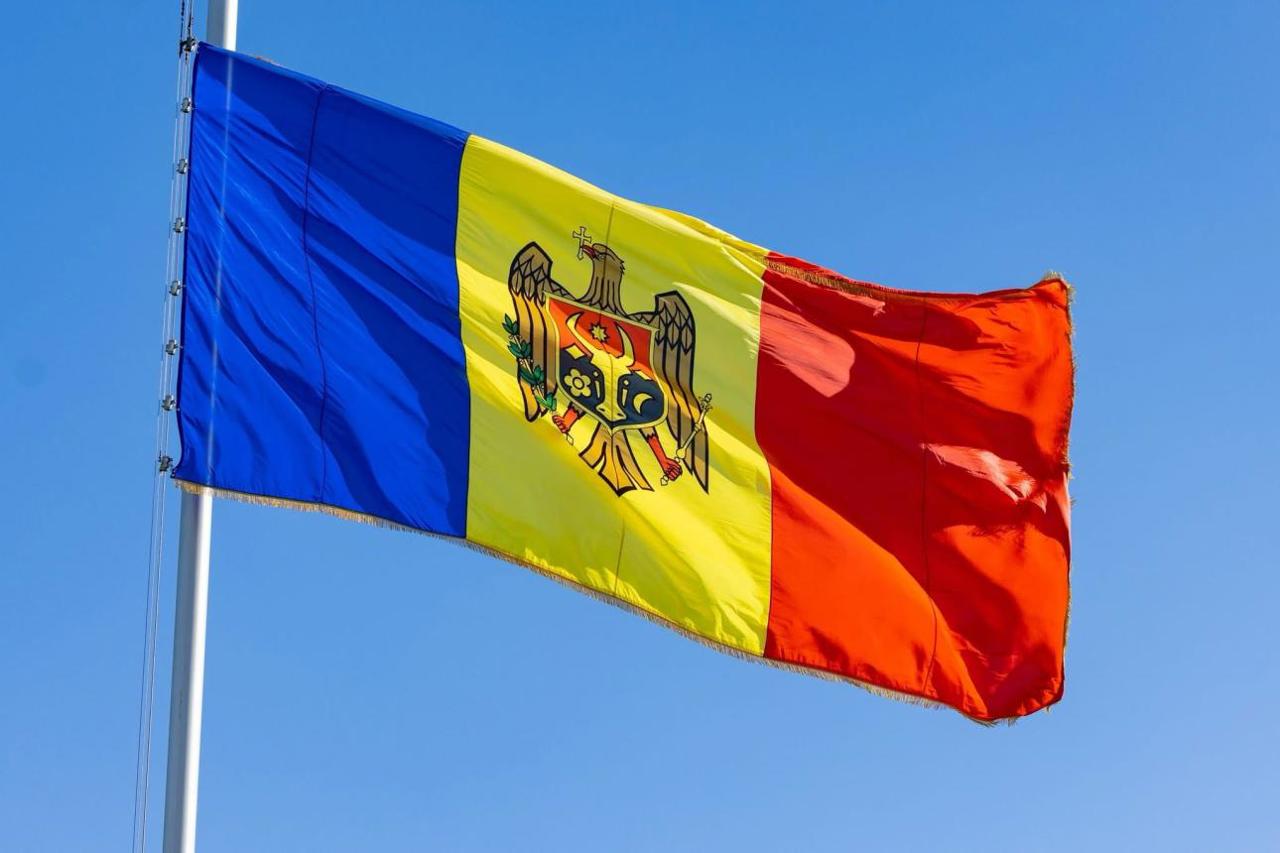
The sky, the fields, and the movement
After being banned during the Soviet occupation starting in 1940, the tricolor flag was publicly raised for the first time in Chisinau on February 19, 1989, at the Summer Theater. It quickly became the symbol of the National Renaissance Movement.
The desire to restore the three colors was solidified at the Constitutive Congress of the Popular Front on May 20, 1989. This was followed by a resolution from the Grand National Assembly on August 27, 1989, which requested the official adoption of the tricolor along with the historical coat of arms of Moldova.
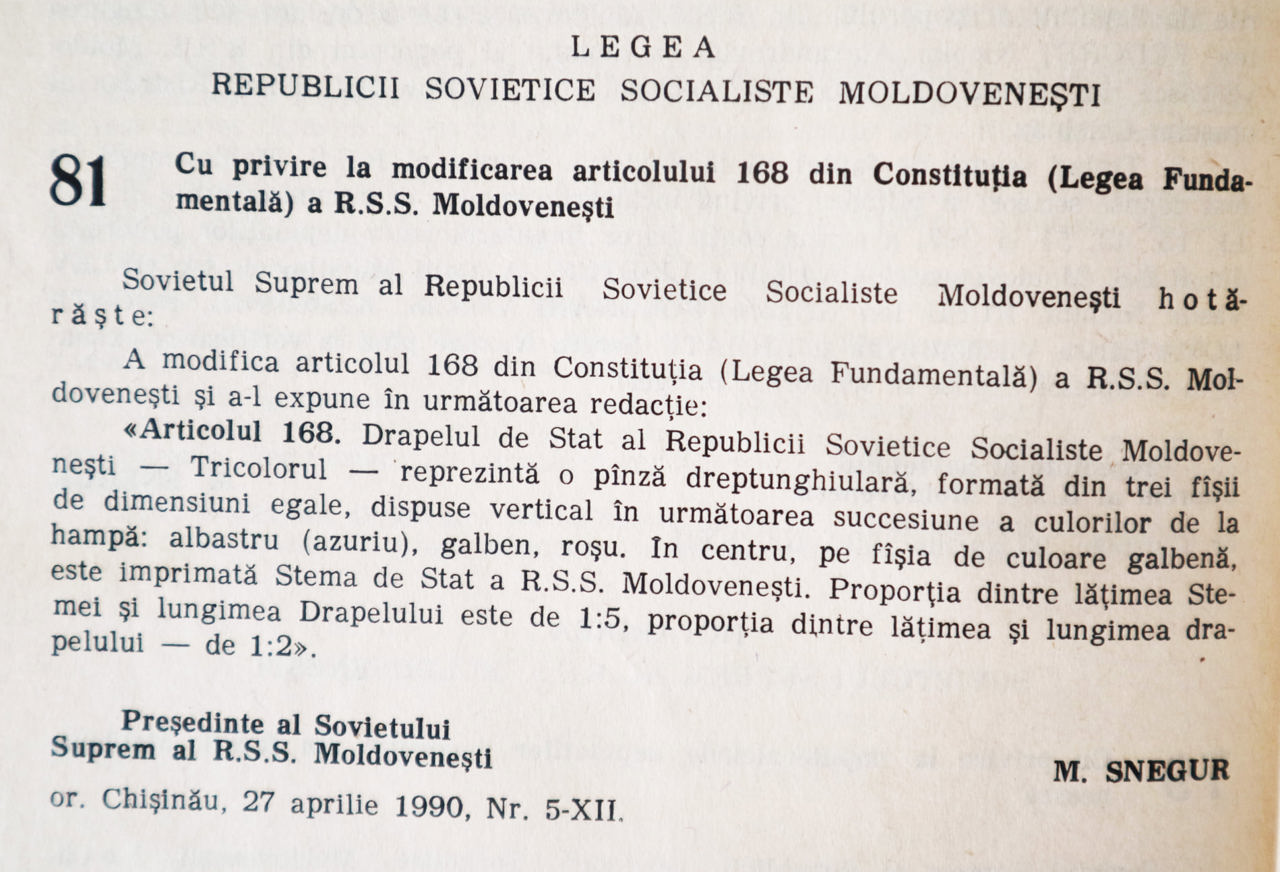
A pivotal moment occurred during the historic meeting of the Supreme Soviet on April 27, 1990. Under pressure from the public and in anticipation of the May Day demonstrations—traditionally dominated by the USSR flag—the deputies passed a law amending Article 168 of the Constitution, officially restoring the tricolor as the State Flag.
The coat of arms, featuring the head of an ox with an eight-pointed star between the horns, was later approved on November 3, 1990. During this time, the tricolor, which represents Romanians everywhere, was used prominently for six months.
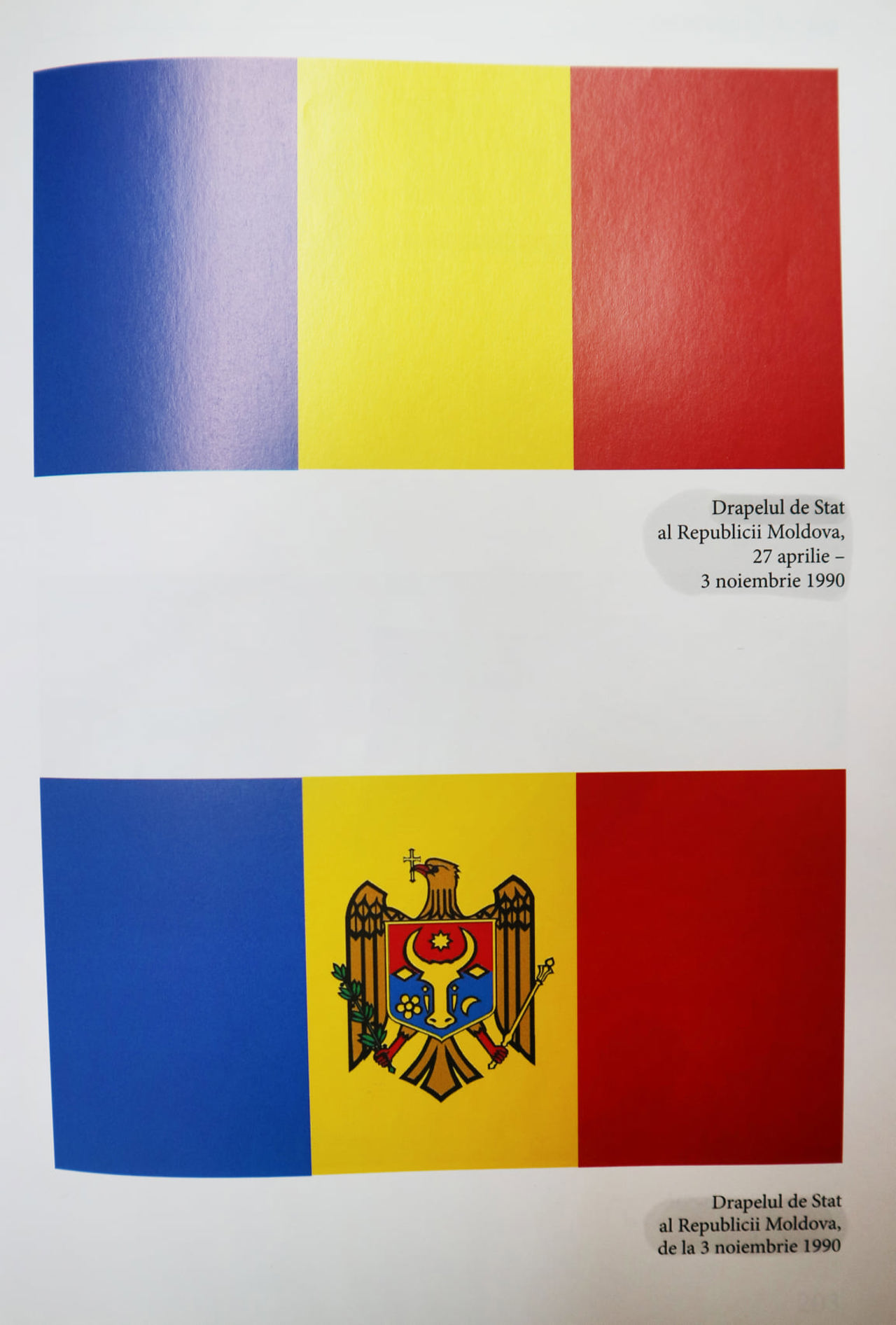
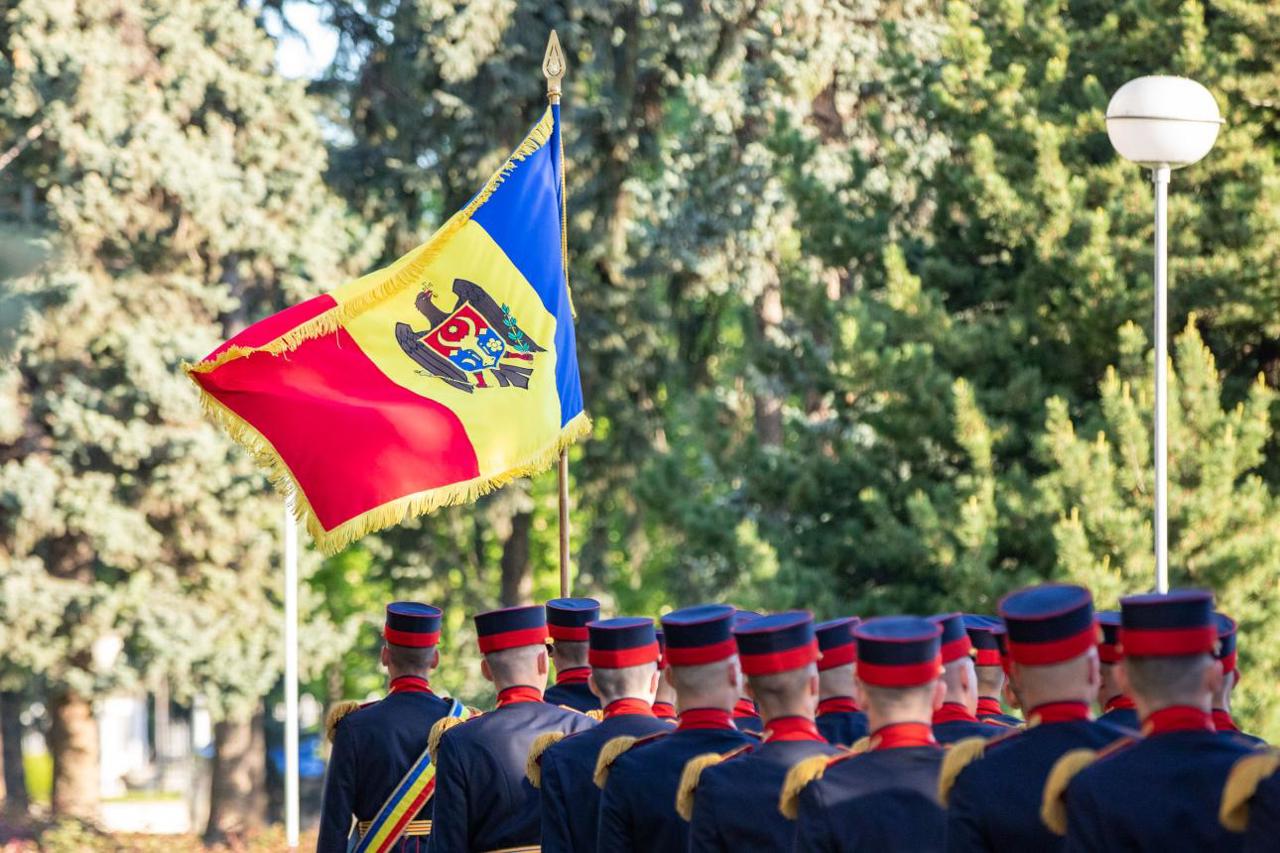
The State Flag of the Moldovan Soviet Socialist Republic, known as the Tricolor, consists of a rectangular cloth divided into three equal vertical stripes. From the hem, the colors are arranged in the following order: blue (azure), yellow, and red. In the center of the yellow stripe, the State Coat of Arms of the Moldovan SSR is displayed. This design is stipulated by the law that amended Article 168 of the Constitution of the Moldovan SSR.
The historian Alexandru Moșanu spoke at the legislative forum about the significance of the national flag's three colors: "The color blue symbolizes the clear sky, peace, and a sovereign life free from war. The color yellow represents the rich harvests of wheat and barley fields that ripen under the southern sun. The color red stands as a revolutionary symbol of the new society, embodying progress toward peace, democracy, and social advancement."
Gheorghe Ghimpu: The first to raise the flag on the Parliament Building
The late Gheorghe Ghimpu, a deputy in the first Parliament of the country, was the one who took down the Soviet flag and raised the tricolor on the Parliament building, which now houses the Presidency of the Republic of Moldova.
"I wasn't afraid of heights. Climbing up with the tricolor that had been voted on by the deputies—a small flag I carried in my hand—I wasn’t scared of losing it; I held it so tightly that my nails dug into my palm. When I got up there and saw the large flag, six meters long, I had to help secure it. I grabbed one corner and held it tightly, thinking, what would happen if the wind took it away?" Gheorghe Ghimpu recounted in an interview with Radio Moldova during that time.
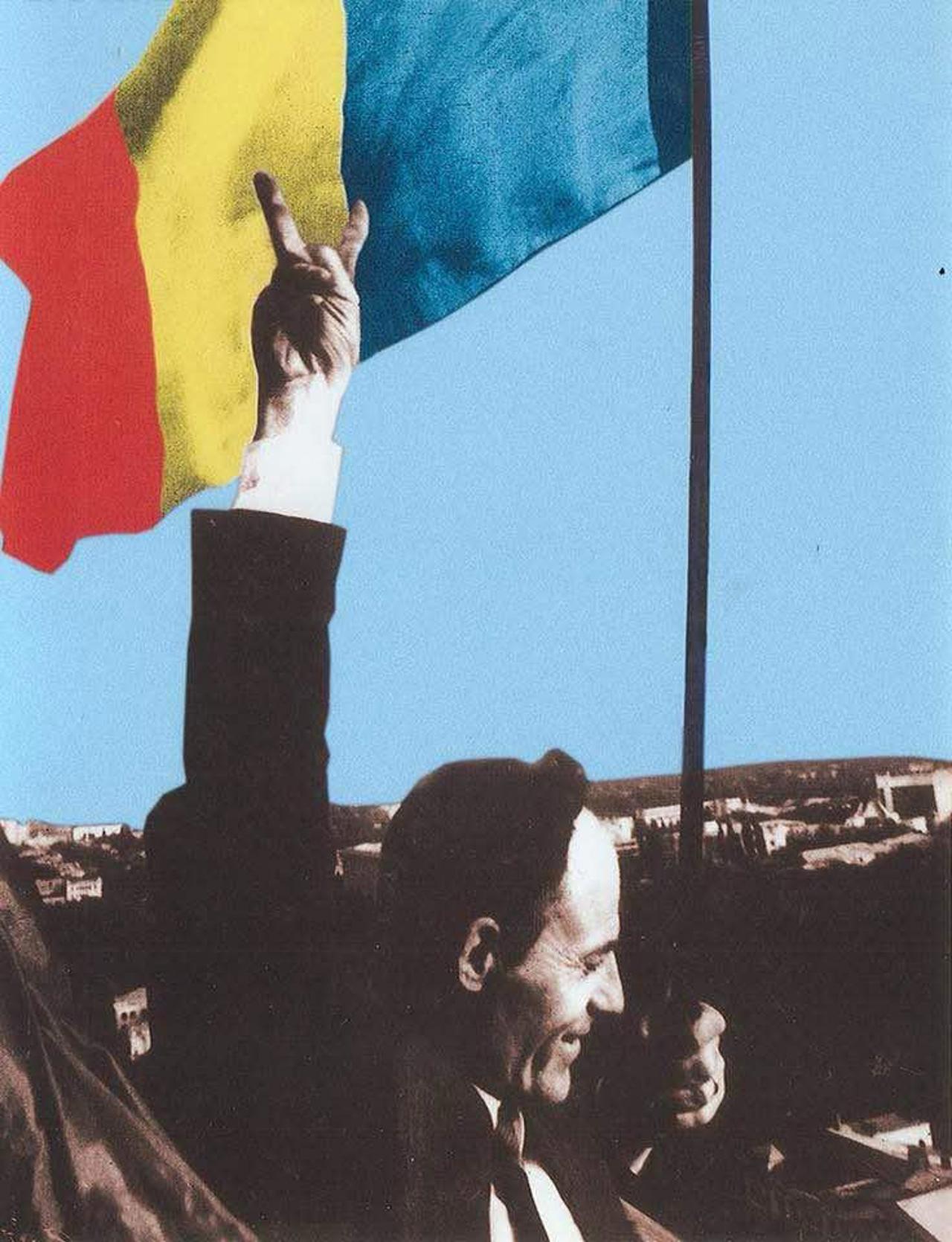
Gheorghe Ghimpu said he had been waiting for this event for many years, which is why he was overwhelmed with emotion on that “victorious” day.
“I didn't know what to say. Here were photographers taking pictures of me while people were shouting below. I looked up at the tricolor flag and thought that even if I were to fall from there, I had witnessed a victory—a victory I had been waiting for for many years. This was during a time when I was still operating in illegality, while we were working and thinking about the founding of the National Patriotic Front. Of course, in our program, the return to the tricolor was a key point. I experienced intense emotions; I couldn't compose myself. I carried the tricolor, which had been voted on by the deputies, and went with the people to the train station, not fully realizing what was happening,” Gheorghe Ghimpu recalled on the national radio station.
Two years in prison for the "Victory" of the Tricolor
Before this “victory,” flying the tricolor had been regarded as an act of high treason for nearly five decades, leading to repression and condemnation by the Soviets. However, there were brave individuals who defied the system.
The most emblematic case is that of Gheorghe Muruziuc. On June 28, 1966, to symbolically mark 26 years since the occupation of Bassarabia, this electrician at the sugar factory in Biruința, now the village of Alexăndreni in the Sângerei district, committed an act of incredible courage: he climbed the factory's chimney, reaching a height of 60 meters, and displayed a tricolor flag that he had made.
For several hours, under the astonished gaze of the workers, the flag waved defiantly as Muruziuc resisted the militia's attempts to take it down.
The cost of freedom was steep: the KGB accused him of “nationalist agitation,” and Soviet justice sentenced him to two years in a labor camp in the Ural Mountains.
Gheorghe Muruziuc was rehabilitated in 1991 and posthumously awarded the “Order of the Republic” in 2010.
Returning to the Tricolor: A natural decision
Researchers have various perspectives on the origins of the tricolor flag.
Some historians trace its official beginning to 1834, when Alexandru Ghica, the ruler of Wallachia, proposed a flag featuring red, blue, and yellow stripes. Later, in 1861, Alexandru Ioan Cuza declared the tricolor as the official civil flag of the United Romanian Principalities.
State heraldist Silviu Tabac, however, points out that the tricolor's emergence, inspired by the flag of France, is closely linked to the spirit of the revolutionary movements of 1848.
“The appearance of the tricolor cannot be considered older than the Revolution of 1848. The exact date is known – the Revolution in Paris succeeded on February 24, 1848. The Moldovan and Wallachian students present there, alongside representatives from other nations, went to greet revolutionary France at the city hall. Each national delegation created its own revolutionary flag. The Moldovan and Wallachian students, who were often the sons of boyars able to study in Paris, designed theirs by imitating the long-established French tricolor flag, which was blue, white, and red. The Romanians replaced the white with yellow. Since then, the tricolor has spread to all three Romanian regions,” explains Silviu Tabac.
Moreover, evidence shows that in the early 1900s, the emancipation movements of Bassarabian Moldovans under the Russian Empire were conducted under the tricolor flag, which later became the national flag of the Moldovan Democratic Republic established in 1917. Under this same flag, the Union of Bassarabia with Romania occurred in 1918.
Thus, the return to the three national colors in the early 1990s, alongside the revival of the Romanian language and the Latin alphabet, represented a natural decision for the historical region of Moldova, which became, due to the complexities of history, the modern Republic of Moldova.
State Flag Day has been observed on April 27 since 2010, following the adoption by Parliament of Law No. 217, which establishes the State Flag as a "major official symbol of the sovereignty and independence of the Republic of Moldova," making respect for it a fundamental duty of every citizen.