Moldovan plums in Paris are four times pricier than in Chișinău
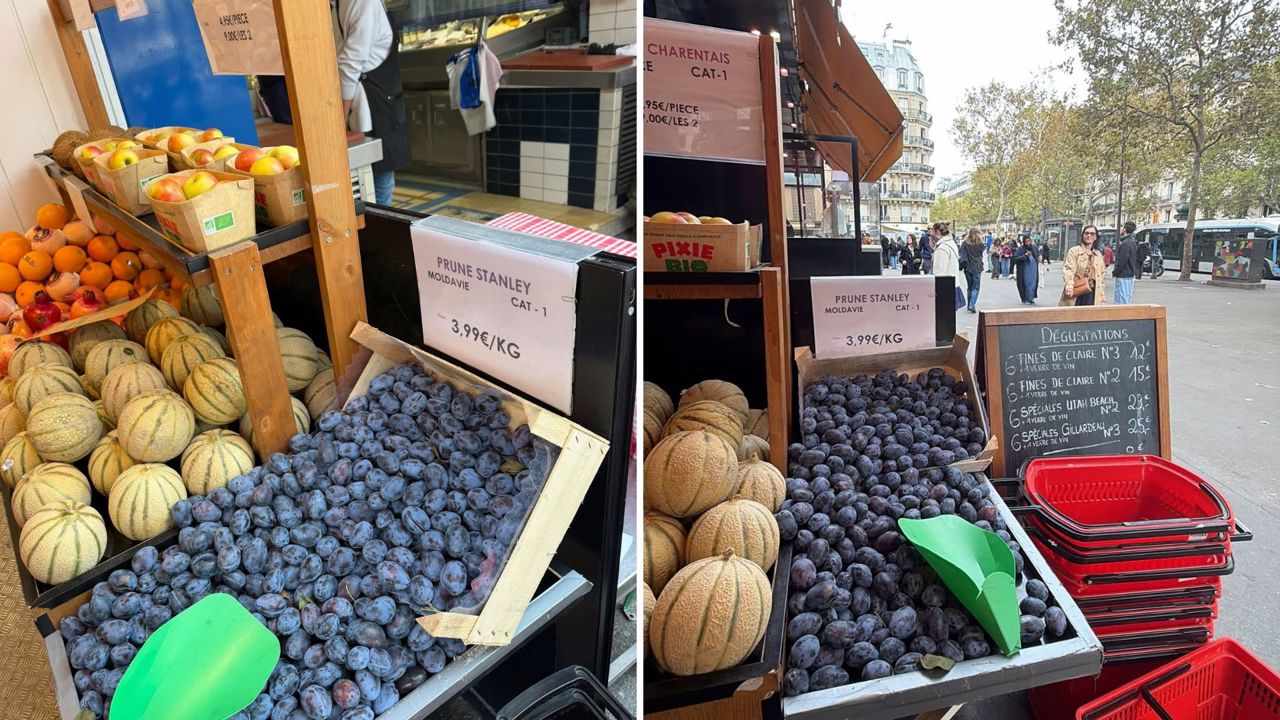
Plums from the Republic of Moldova are available in markets across Paris, France, for €3.99 per kilogram—around 80 Moldovan lei. Labeled as Category I, the fruit meets commercial quality standards and stands out for its attractive appearance.
According to images posted by social media users, Stanley plums—one of the most popular and widely cultivated varieties—are displayed alongside other fruits, including melons, apples, and oranges.
The label indicates a price of 3.99 euros per kilogram. Based on the official exchange rate of the National Bank of Moldova, a kilogram of plums in Paris costs approximately 80 Moldovan lei—four times the price in Chișinău, where the fruit sells for an average of 12 to 20 lei.
In recent years, the Republic of Moldova has reoriented its foreign trade toward the European Union, which absorbs over 67% of its export volumes. Romania is the primary market for Moldovan products, followed by Ukraine, Italy, Turkey, and Germany.
These trends have also influenced the plum sector. While plums were previously exported predominantly to Commonwealth of Independent States (CIS) countries, approximately 85% now reach European Union markets.
Germany, Romania, and Poland have become key destinations, and the later harvest season offers Moldovan producers a competitive advantage. In 2025, over 22.3% of exported plums went to Germany, and exporters achieved prices averaging 35% higher than in 2023, according to economist Veaceslav Ioniță.
At the same time, Romania remains a vital market for Moldovan plums, absorbing 18.6% of exports for this product. Overall, the Republic of Moldova's foreign trade exceeded €6.2 billion in 2025, with service exports surpassing €2.8 billion, according to the Investment Agency's report on the country's export offer.
In 2025, the European Union eliminated customs duties on seven agricultural products from the Republic of Moldova as part of efforts to deepen bilateral trade relations. This concerns plums, table grapes, apples, tomatoes, garlic, cherries, and grape juice—products which, although already exported to the EU market, do not yet benefit from full liberalization.