Bank fraud recovery: 2.95 billion lei recovered from over 14 billion converted to public debt
Repayment of emergency loans granted to the three banks involved in the banking fraud has stalled over the last three months. Between June 30 and September 30, 2026, the amount recovered from the liquidation of Banca de Economii, Banca Socială, and Unibank remained unchanged at approximately 2.95 billion lei, according to data from the Ministry of Finance.
During the same period, the value of recovered assets increased by approximately 5.5 million lei. Meanwhile, the state continues to pay off—from the public budget—the debt resulting from the emergency loans granted to rescue the three banks in 2014–2015.
According to the Ministry of Finance, as of September 30, 2026, the total value of assets recovered from Banca de Economii, Banca Socială, and Unibank had reached 3.1 billion lei, compared to the 3.09 billion lei recorded at the end of June.
Thus, in the third quarter, the amount recovered increased by only about 5.5 million lei.
Nevertheless, the sum reported as repayment for the emergency loans—including interest—remained at 2 billion 953 million lei. This figure did not change between the two reporting periods.
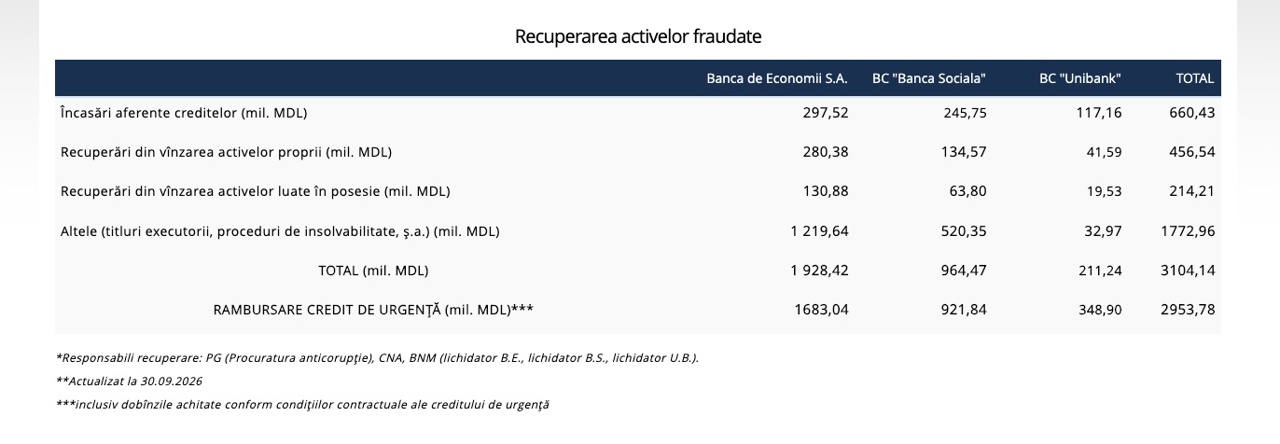
Of the total assets recovered by the end of September, the largest share belongs to Banca de Economii—approximately 1.93 billion lei—followed by Banca Socială with 964.47 million lei, and Unibank with 211.24 million lei.
The bulk of these funds—about 1.77 billion lei—was derived from enforcement orders, insolvency proceedings, and other similar mechanisms.
Additionally, over 660 million lei was obtained from loan repayments, approximately 456 million lei from the sale of the banks' own assets, and more than 214 million lei from the liquidation of assets taken into possession.
Over 14 billion lei in loans to bail out the three banks
According to anti-corruption prosecutors, an organized group of oligarchs and politicians orchestrated the massive extraction of funds from Banca de Economii, Banca Socială, and Unibank between 2012 and 2014, using complex "carousel" loan schemes.
To prevent public panic and a total collapse of the national financial system, the government led by Iurie Leancă approved the issuance of state guarantees in November 2014.
Based on these guarantees, the National Bank of Moldova (NBM) issued emergency loans totaling 14.12 billion lei to cover the resulting financial shortfalls. Banca de Economii received approximately 9.27 billion lei, Banca Socială received 2.7 billion lei, and Unibank received around 2.15 billion lei.
However, a large portion of these emergency loans was fraudulently siphoned off abroad before the NBM (National Bank of Moldova) placed the banks under special administration.
Shortly thereafter, the banks entered liquidation and could not repay the funds. In October 2016, the state converted these guarantees into public debt by issuing government bonds totaling approximately 13.34 billion lei, which were transferred to the National Bank of Moldova.
Through this mechanism, the financial burden shifted to the state budget and citizens; the debt is to be repaid in instalments—including interest—by 2041.
Concurrently, the liquidators of the three institutions are attempting to recover funds by liquidating assets, collecting receivables, and pursuing other legal measures.
Although the recovered funds contribute to the partial settlement of obligations related to the emergency loans, they do not negate the state's obligation to adhere to the established repayment schedule for the public debt.
According to data from the Ministry of Finance, as of the third quarter of 2026, approximately 2.95 billion lei—including interest—had been repaid out of the total of over 14 billion lei in emergency loans. This amount represents roughly 21% of the value of the loans originally granted.