Nearly 7,000 hectares of farmland will gain modern irrigation
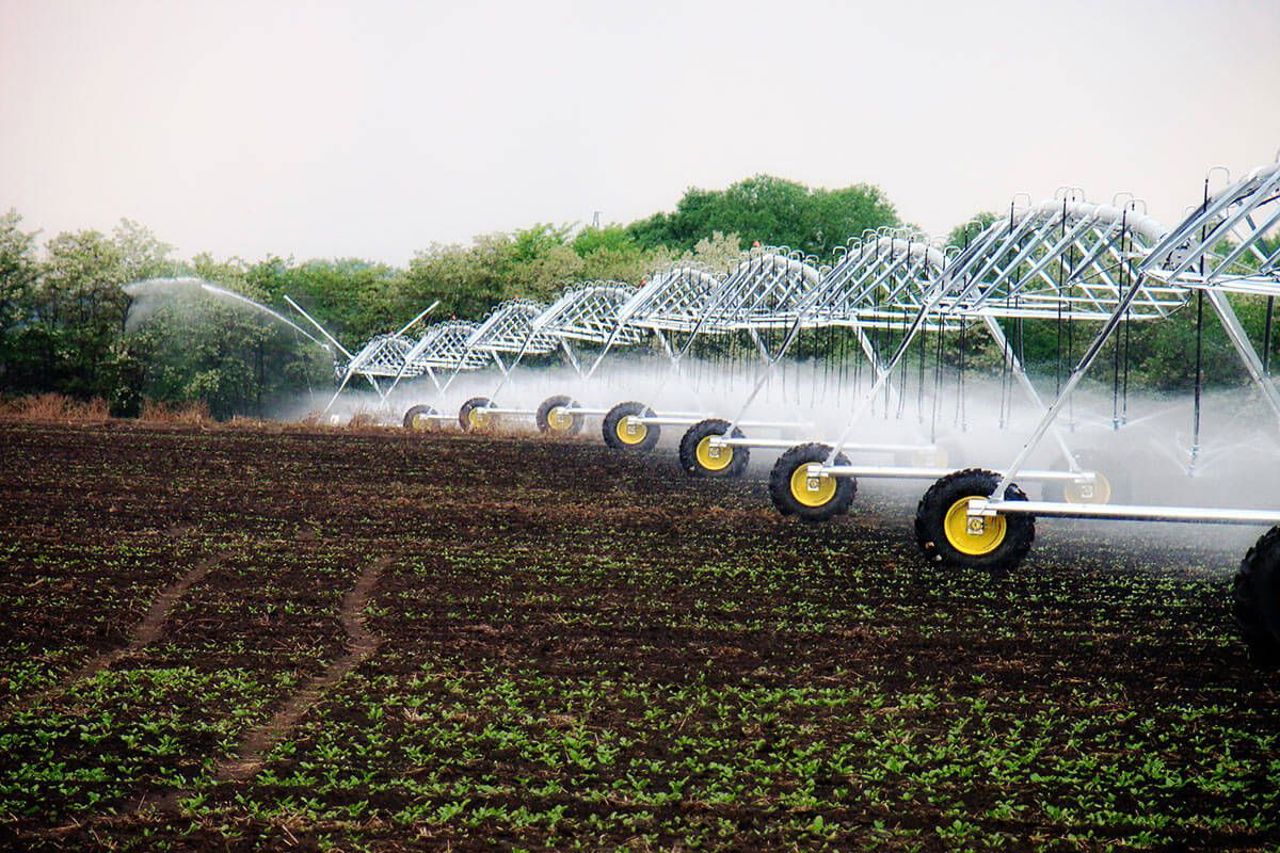
Nearly 7,000 hectares of agricultural land in the Căușeni, Anenii Noi, and Ștefan Vodă districts will be irrigated following an infrastructure rehabilitation project, financed through a loan of nearly 103 million euros from the European Bank for Reconstruction and Development (EBRD), with support from the European Union and national contributions. The project entails modernising the centralised irrigation systems in Căușeni and Puhăcenii de Sus; the former is currently non-functional, while the latter irrigates only a portion of the area it is intended to serve.
The investment aims to improve farmers' access to water and strengthen their capacity to use infrastructure efficiently, as droughts and diminishing water resources increasingly affect agriculture.
Svetlana Ghetmancenco, Director of the National Agency for Land Improvement (ANIF), stated in an interview for the Radio Moldova program "Zi de Zi" that the project will enable the rehabilitation of two centralized irrigation systems, covering a total area of approximately 6,900 hectares.
"Indeed, through this project—funded by the European Bank for Reconstruction and Development—two centralized irrigation systems will be repaired: the Căușeni complex and the Puhăcenii de Sus centralized system," the ANIF Director said.
According to her, the investments will not be limited to infrastructure works; they will also include measures to build the capacity of farmers and the management of water user associations for irrigation. These efforts are intended to contribute to more efficient system management and the productive use of water resources.
One system is non-functional, while the other allows for only partial irrigation of the land
The two irrigation systems are in different conditions. In Puhăcenii de Sus, the existing infrastructure allows for the irrigation of approximately 2,300 hectares; however, some components are damaged, which prevents the system from reaching its full potential.
In contrast, the Căușeni complex is in an advanced state of degradation and requires complete rehabilitation. Currently, the system is not functional, and the agricultural land within its coverage area cannot be irrigated.
"In the Căușeni area, however, the system is non-functional; it is in a deteriorated state and requires complete rehabilitation. Consequently, no irrigation is taking place there at the moment," explained Svetlana Ghetmancenco.
Reconstructing infrastructure: from water intake to field distribution
The technical project entails interventions on the core components of the irrigation systems. The work will focus on reconstructing water intake systems and pumping stations, rehabilitating pipeline networks and hydrants, and developing water storage infrastructure.
The goal is to ensure the continuous and efficient operation of these systems, allowing farmers to access water for crop irrigation—safely and with improved management of available resources.
Farmers will contribute approximately 3% of the costs
In addition to external funding and national contributions, the project includes a financial contribution from farmers who own land within the service area of the rehabilitated irrigation systems. Their share will amount to approximately 3% of the projected costs.
According to the director of ANIF, this financial involvement from the beneficiaries is intended to foster a sense of responsibility regarding the operation and maintenance of the infrastructure, which is transferred—via a loan-for-use agreement—to irrigation water user associations. "This is a requirement from both the Ministry of Agriculture and the Government; we consider it a very favorable condition, and the contribution expected from farmers who own land within the irrigation system's coverage area is approximately 3%," noted Svetlana Ghetmancenco.
She explained that the farmers' financial participation should foster a greater sense of responsibility toward the modernized infrastructure and encourage its proper long-term operation.
Necessary investments amid declining water resources
The modernization of irrigation systems is becoming increasingly critical for agriculture in the country's southeastern region, given the recurring droughts and the diminishing availability of water resources. The Director of ANIF noted that the current hydrological situation requires identifying new solutions to secure water for irrigation.
Although water resources in the Nistru and the Prut river basins are dwindling, infrastructure investment remains essential to reducing farmers' vulnerability to drought.
Svetlana Ghetmancenco emphasized that, beyond rehabilitating existing systems, innovative strategies are needed to improve the planning and securing of water reserves for the agricultural season.
Consequently, the project to modernize the Căușeni and Puhăcenii de Sus systems represents a significant investment for farmers in the region, as it expands the area that can be irrigated and improves the conditions for agricultural activities amidst an increasingly challenging climate.
Author: Svetlana Bogatu